

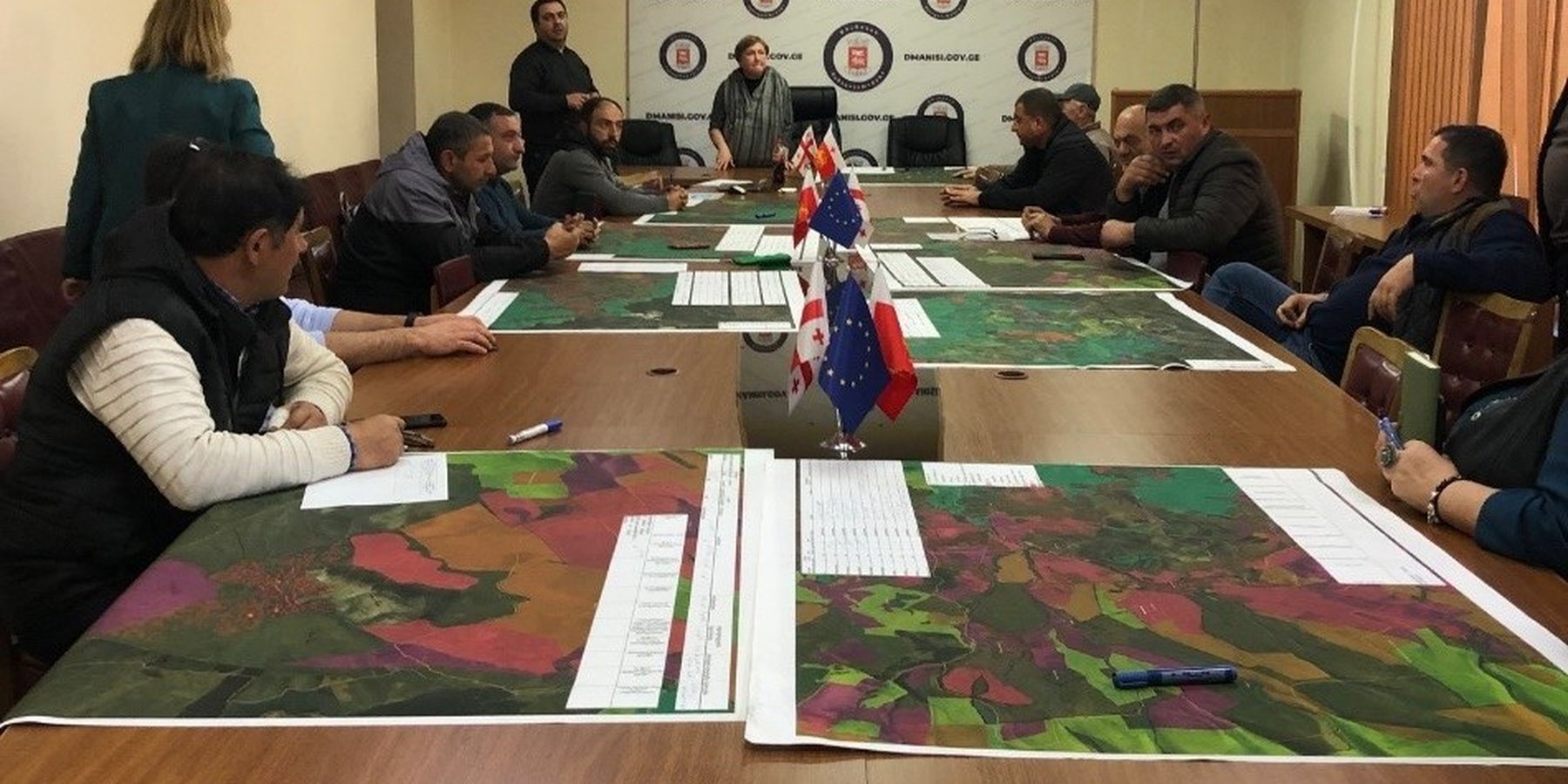
Municipal Pastureland Planning [Géorgie]
- Création :
- Mise à jour :
- Compilateur : Nicholas Euan Sharpe
- Rédacteur : –
- Examinateurs : William Critchley, Joana Eichenberger
საძოვრების მართვის დაგეგმვა მუნიციპალურ დონეზე
approaches_7569 - Géorgie
Voir les sections
Développer tout Réduire tout1. Informations générales
1.2 Coordonnées des personnes-ressources et des institutions impliquées dans l'évaluation et la documentation de l'Approche
Personne(s) ressource(s) clé(s)
Project partners, land users, stakeholders of GCP/GEO/006/GFF, Regional Environmental Centre for the Caucasus (REC Caucasus) as article developer:
Nom du projet qui a facilité la documentation/ l'évaluation de l'Approche (si pertinent)
Achieving Land Degradation Neutrality Targets of Georgia through Restoration and Sustainable Management of Degraded Pasturelands (GCP/GEO/006/GFF)Nom du ou des institutions qui ont facilité la documentation/ l'évaluation de l'Approche (si pertinent)
Regional Environmental Centre for the Caucasus (REC Caucasus) - Géorgie1.3 Conditions relatives à l'utilisation par WOCAT des données documentées
Quand les données ont-elles été compilées (sur le terrain)?
2024
Le compilateur et la(les) personne(s) ressource(s) acceptent les conditions relatives à l'utilisation par WOCAT des données documentées:
Oui
1.4 Références au(x) questionnaire(s) sur les Technologies de GDT
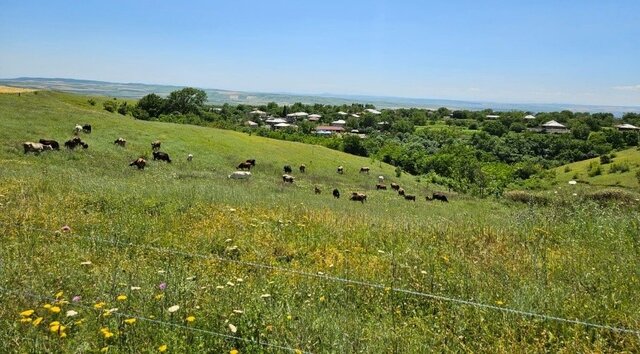
Controlled Grazing [Géorgie]
“Controlled Grazing” seeks to harness the behaviours and habits of ruminant livestock to enhance three key ecological functions, namely the removal of plant biomass (grazing), soil and vegetation disturbance (animal impact) and increased nutrient cycling (dung and urine), with the goal of increasing perennial grass establishment, pasture palatability and reducing …
- Compilateur : Nicholas Euan Sharpe
2. Description de l'Approche de GDT
2.1 Courte description de l'Approche
The Municipal Pastureland Planning approach was developed collaboratively with key national and local stakeholders to establish a structured, evidence-based decision support framework for sustainable rangeland governance. This system consolidates and presents data from diverse stakeholder groups in a format fully compatible with the Land Degradation Neutrality Framework, ensuring that planning aligns with both environmental and socio-economic objectives.
2.2 Description détaillée de l'Approche
Description détaillée de l'Approche:
The Municipal Pastureland Planning approach was developed through close collaboration with national and municipal stakeholders, and was designed to operate at two interrelated levels, as defined by the National Pastureland Management Policy Concept and forthcoming Law on Pasture Management, namely:
1. Upper tier planning - Participatory pasture planning at the municipal scale.
2. Lower tier implementation - Pasture management planning and SLM technology application at the level of individual pasture units (which was piloted in villages and is the subject of the WOCAT database entry on the “Controlled Grazing” technology).
To achieve these goals and provide a practical model for other municipalities and national policy, the Municipal Pastureland Planning approach piloted included the following components:
a) spatial distribution of pastures according to ownership forms and use regimes (identification of common use pastures and pastures for leasing);
b) identification of pasture users and number of livestock according to administrative units and municipal census;
c) Assessment of current practices of livestock farming and pasture use;
d) Analyses of the results of pasture monitoring or pastures multi-factor assessments including land degradation rates (see the WOCAT database entry on the Participatory Rangeland and Grassland Assessment - PRAGA);
e) Identification and stakeholder consensus of priority pastures for restoration and measures for their restoration;
f) Assessment of optimal pasture carrying capacity and actual stocking rates;
g) Investments needed in pasture infrastructure development;
h) Implementation plan and estimated budget; and
j) Monitoring programme for the implementation of the plan and corrective measures.
Municipal Pastureland Planning functions as a stepwise instruction manual for carrying out these components in accordance with the Land Degradation Neutrality (LDN) conceptual framework. The process can require access to cadastral and land tenure data, often requiring coordination and approval from local and state authorities to ensure access and consistency across datasets.
The participatory stakeholder approach has brought to light common themes across the three pilot municipalities:
•The critical need to formalize access rights and clarify pasture tenure;
•Challenges related to low organizational capacity among pasture users;
•The importance of community engagement for identifying investment priorities and restoration areas; and
•The necessity of linking local-level decisions to national LDN targets and broader agricultural strategies.
Ultimately, Municipal Pastureland Planning provides Georgia with a replicable framework for achieving LDN at multiple governance levels. By combining spatial data analysis, stakeholder participation, and evidence-based planning, it strengthens municipal capacity, supports sustainable land use, and contributes directly to the national LDN targets — particularly Target #1 (mainstreaming LDN into policies and planning) and Target #4 (rehabilitation of degraded lands). The experience gained through the pilot municipalities demonstrates that structured, participatory pasture planning can serve as a cornerstone for sustainable rural development and the long-term resilience of Georgia’s pastures and grazed ecosystems.
The approach was developed and tested under the GEF-funded project “Achieving Land Degradation Neutrality Targets of Georgia through Restoration and Sustainable Management of Degraded Pasturelands (GCP/GEO/006/GFF)”, which piloted the participatory approach through the development of municipal-scale pasture plans for three Georgian municipalities.
2.3 Photos de l'approche
Galerie Médias
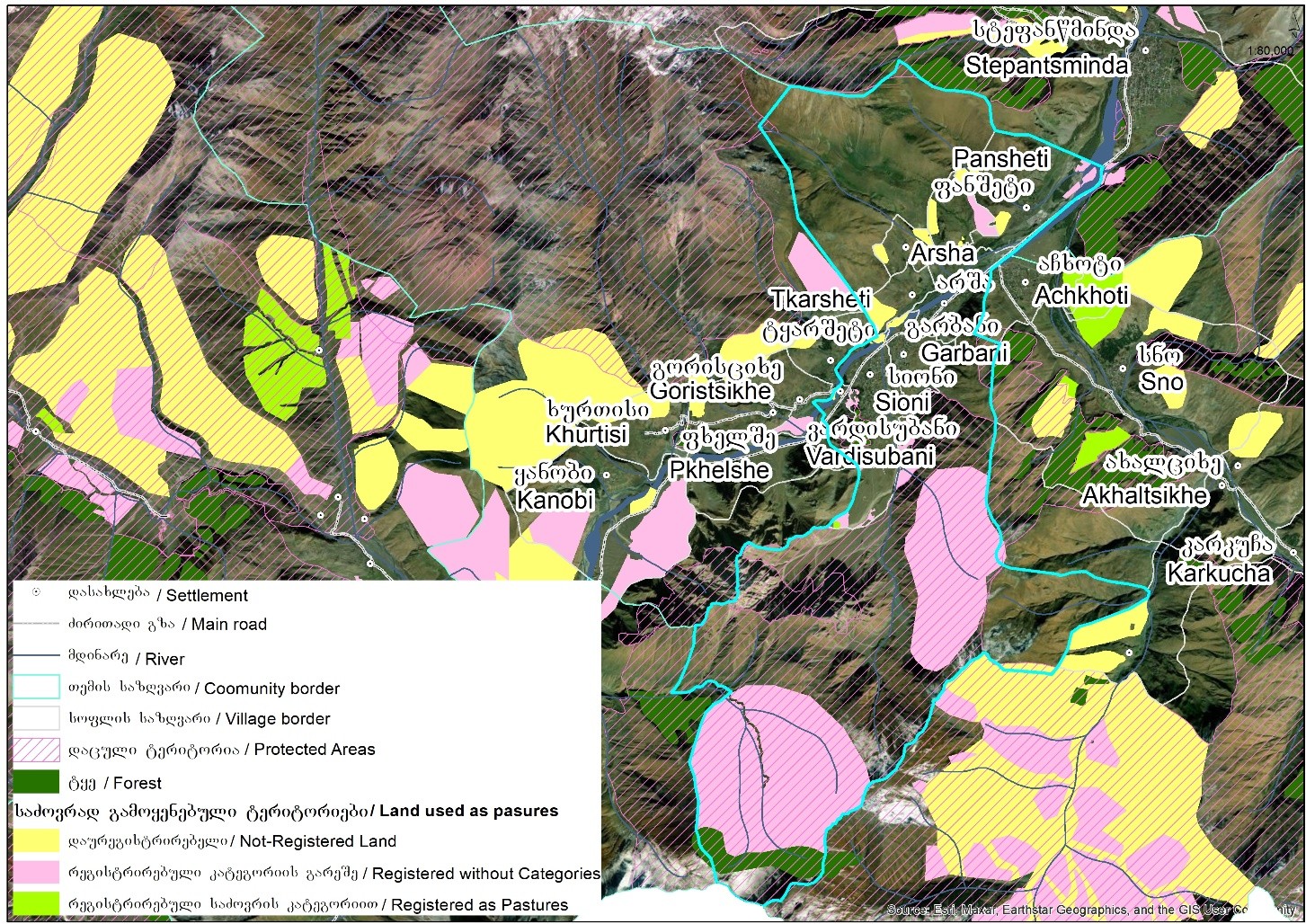
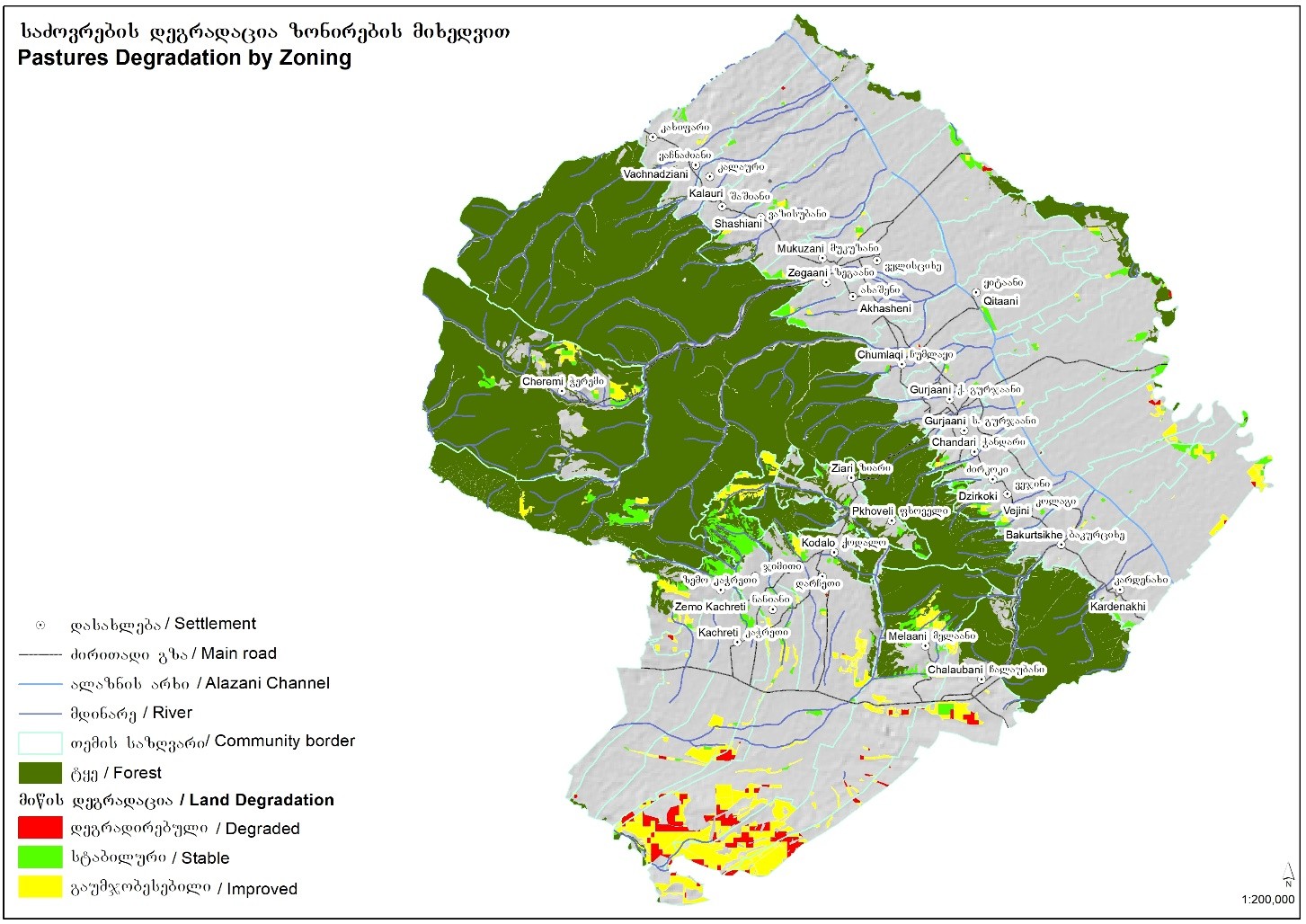
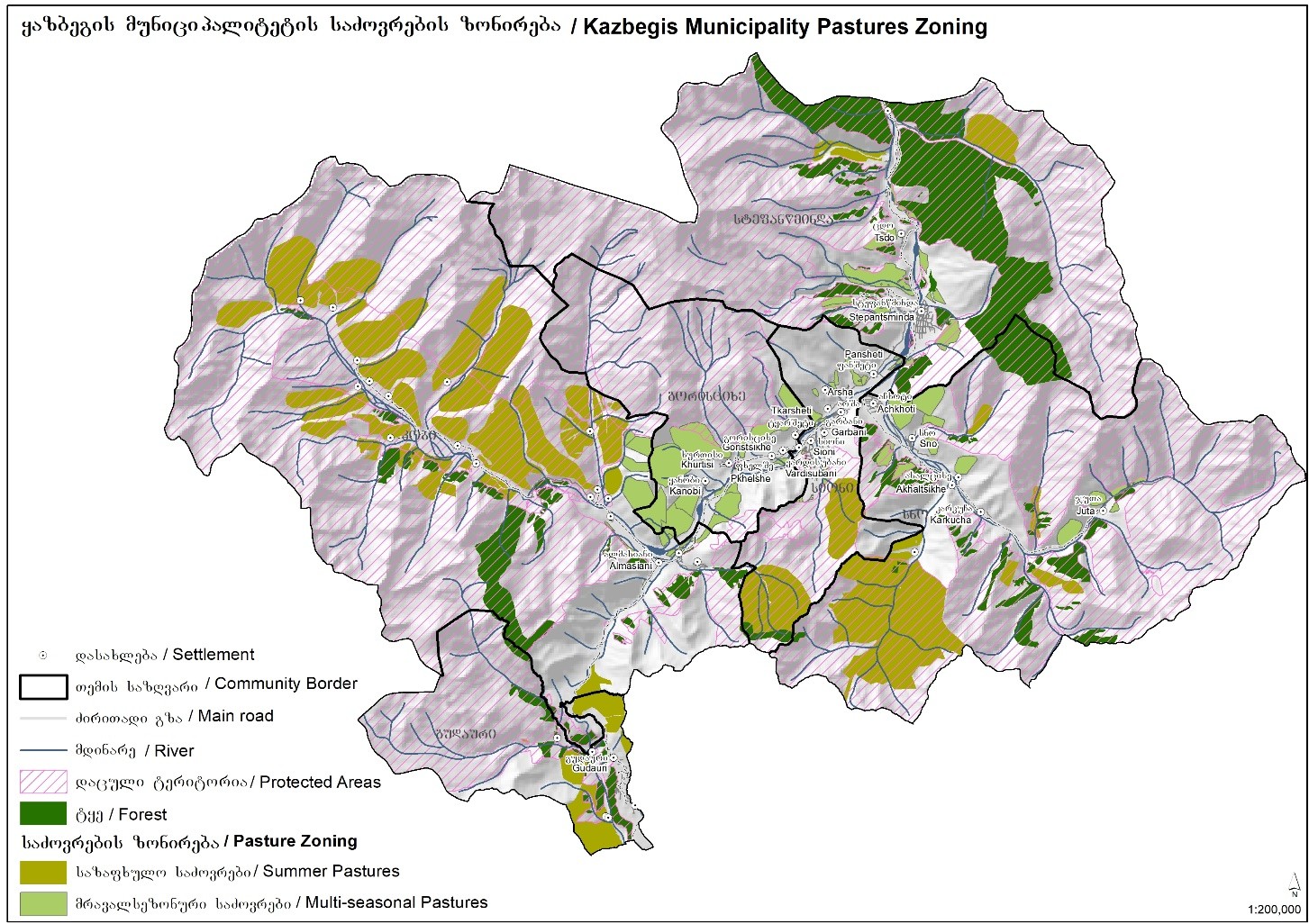
2.5 Pays/ région/ lieux où l'Approche a été appliquée
Pays:
Géorgie
Région/ Etat/ Province:
The Georgian Municipalities of Dmanisi, Gurjaani and Kazbegi
Commentaires:
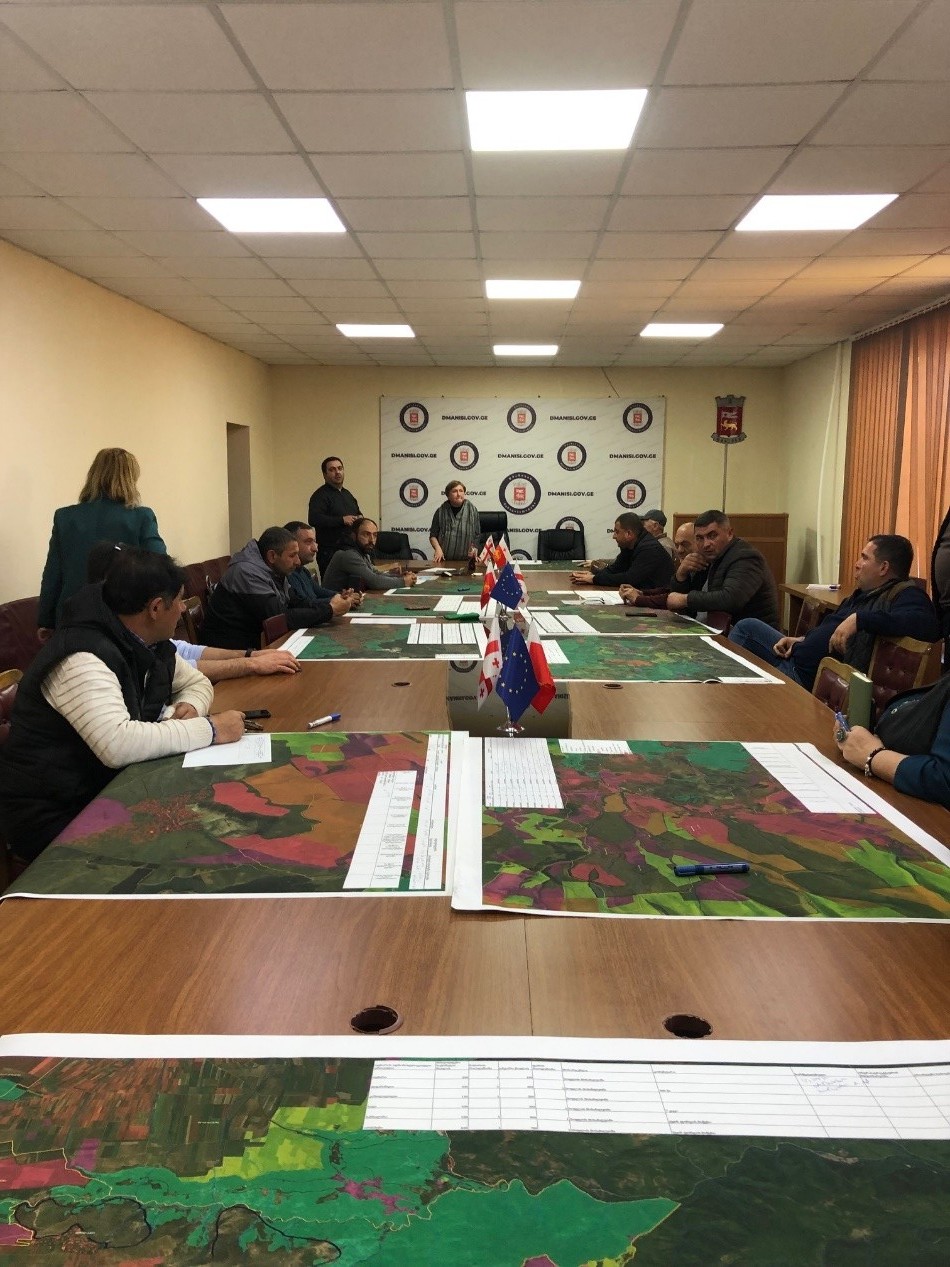
The Municipal Pastureland Planning approach was piloted in the municipalities of Dmanisi, Gurjaani, and Kazbegi on categorised pasture areas.
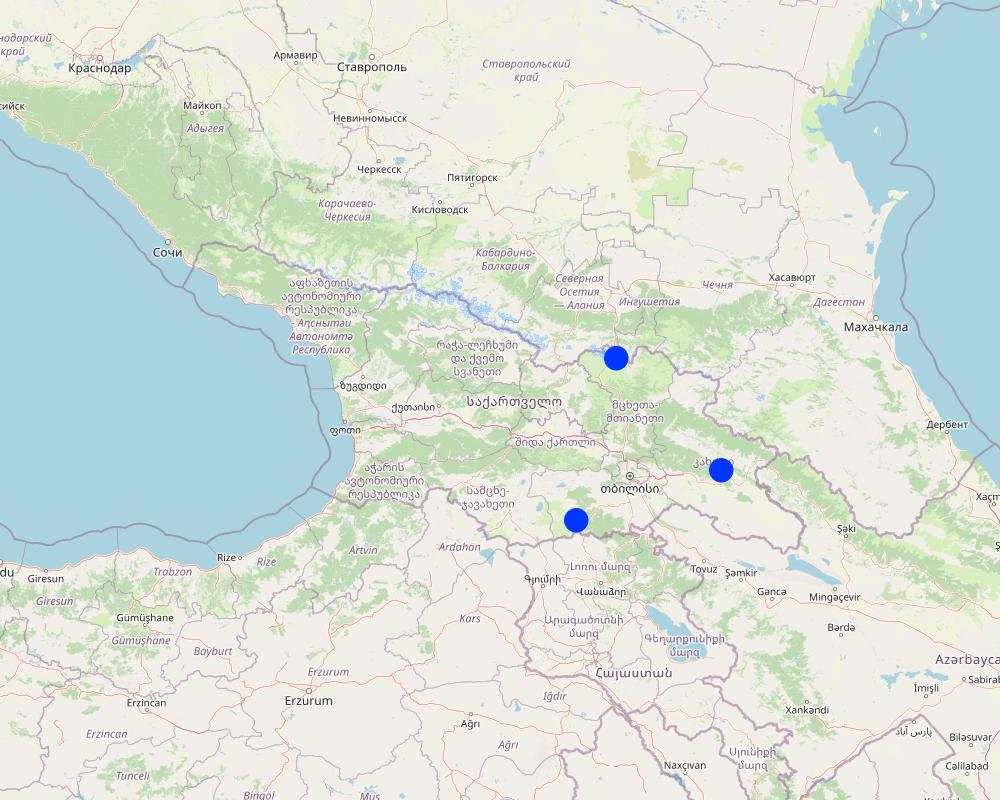
Map
×2.6 Dates de début et de fin de l'Approche
Indiquez l'année de démarrage:
2021
Date (année) de fin de l'Approche (si l'Approche n'est plus appliquée):
2025
Commentaires:
The Municipal Pastureland Planning approach was developed and piloted in 3 Georgian Municipalities through the 'Achieving Land Degradation Neutrality Targets of Georgia through Restoration and Sustainable Management of Degraded Pasturelands', initiated by the Ministry of Environment Protection and Agriculture of Georgia and implemented by the Food and Agriculture Organization of the United Nations (FAO); the executive organization was the Caucasus Regional Environmental Center (RECC), in partnership with the Caucasus Environmental Non-Governmental Organization Network (CENN).
2.7 Type d'Approche
- fondé sur un projet/ programme
2.8 Principaux objectifs de l'Approche
Municipal Pastureland Planning aims to support sustainable management of pasturelands at the municipal level in alignment with Georgia’s Land Degradation Neutrality (LDN) targets and National Agricultural and Rural Development Strategy. Designed to link municipal authority, land user, and policy decision-making, it provides a structured, transparent, and participatory framework and forum to assess pasture conditions, identify land tenure (both legal and informal), and prioritize restoration or investment efforts. The approach emphasizes evidence-based planning through tools like the Municipal Pastureland Assessment & Monitoring System, combining remote sensing, field data, and stakeholder input to guide long-term decision-making.
By integrating LDN principles, the approach ensures that pasture planning is inclusive, informed, and adaptable, with municipal-wide pasture management plans developed on three to five-year cycles. It focuses on aligning stakeholder goals, transforming data into practical policies, and directing resources to areas showing signs of degradation or ecological change. Ultimately, this approach not only facilitates local-level action but also contributes to broader landscape-scale restoration and national land management objectives, offering a replicable model for scaling up sustainable pastureland practices across Georgia.
It has been integrated into the national government's National Pastureland Management Policy Concept and forthcoming Law on Pasture Management through the efforts of the project's implementation partners.
2.9 Conditions favorisant ou entravant la mise en œuvre de la(des) Technologie(s) appliquée(s) sous l'Approche
normes et valeurs sociales/ culturelles/ religieuses
- favorise
Georgia’s long-standing history of rural cooperation and communal resource management provides a strong foundation for the development of inclusive, municipality-wide pasture management strategies. In Georgia, the lowest level of administrative governance is the municipality (which includes many villages). Therefore, the municipality was chosen as the most appropriate unit for planning.
- entrave
Georgia’s Soviet past disrupted traditional systems of rural cooperation by replacing community-based land management with centralized state control, leading to a loss of local autonomy and trust in formal institutions.
disponibilité/ accès aux ressources et services financiers
- favorise
Georgian rural livestock producers have seen gradual improvements in access to financial resources through government programs like the Preferential Agro Credit Program, which offers subsidized loans, and support from international development projects that provide grants, technical training, and infrastructure development. Some microfinance institutions and rural banks also offer agricultural loans, and there has been progress in expanding veterinary services and market access in more accessible regions.
- entrave
Many livestock producers lack formal land ownership or collateral, making it difficult for them to qualify for loans. Limited financial literacy and weak extension services further constrain their access to finance. In remote and mountainous areas, financial institutions are scarce, and agriculture is often perceived by lenders as high-risk, resulting in limited investment and low uptake of insurance and credit services. Consequently, small-scale producers struggle to secure affordable credit or investment to improve their herds, upgrade infrastructure, or diversify their income, thereby constraining growth.
cadre institutionnel
- favorise
The Ministry of Environmental Protection and Agriculture (MEPA) has been a principal proponent of the project, in addition to its National Agency for Sustainable Land Management and Land Use Monitoring (NASLM), together with the Ministry of Regional Development and National Agency of the State Property (legal entity under the Ministry of Economy and Sustainable Development). With MEPA at the forefront, these entities have been working to develop nation-wide responses to land degradation and sustainable land management initiatives.
collaboration/ coordination des acteurs
- favorise
In Georgia, interagency collaboration between between national and municipal administrations has been steadily improving through policy reforms and participatory processes, with internal government entities and non-governmental organisations supporting decentralisation.
cadre juridique (régime foncier, droits d'utilisation des terres et de l'eau)
- entrave
While the project addresses land tenure issues for specific communities where it worked, Georgia’s legal framework for land tenure and resource use is largely inhibiting for local livestock producers. Centralized control over pastureland, short-term leasing, and lack of secure or communal land rights limit producers’ ability to plan and invest long-term. Incomplete land registration and weak water and grazing regulations further undermine resource access and sustainability.
cadre politique
- favorise
The National Pasturelands Management Policy Concept has been developed with support of the project and validated through stakeholder workshops. The document contributes to the implementation of LDN priorities, sets out the vision and principles for pasturelands governance and management, defines issues of ownership and rights, institutional arrangements, economic and fiscal aspects, land use planning and monitoring. Strategic Environmental Assessment (SEA) of the NPMPD is completed and assess the potential environmental and human health impacts resulting from the implementation of the NPMPD and provides recommendations for preventing, reducing and mitigating the potential impacts. The legislation framework on ``Pasturelands Management`` developed based on NPMPD with a focus on the implementation of LDN principles. The project provides support to the MEPA in discussions of the legislative package on Pasturelands Management with interested Ministries, other governmental and non-governmental organizations.
- entrave
Despite reforms, most pastureland remains under centralized state control, limiting local and municipal authority over land management. Small, fragmented landholdings, weak tenure security, and widespread land degradation hinder sustainable livestock production. Additionally, unclear legal frameworks and the absence of a unified land administration body complicate policy implementation and reduce the effectiveness of land use planning.
gouvernance foncière (prise de décisions, mise en œuvre et application des décisions)
- entrave
Land governance in Georgia largely inhibits livestock production due to centralized decision-making and limited authority for local communities over pasture management. Implementation of land reforms is slow, with many areas lacking formal land registration, which undermines tenure security. Additionally, weak enforcement and unclear responsibilities contribute to ongoing environmental degradation and inefficient land use.
connaissances sur la GDT, accès aux supports techniques
- favorise
Georgia's rural communities are well connected and knowledgable about their natural envrionments and there are well adapted SLM practices and traditions
- entrave
While Sustainable Land Management (SLM) practices are known and applied, the contextual support systems, including agricultural policies, rural demographics, and livestock herding culture, are undergoing significant change. Knowledge and technology gaps limit access to modern farming techniques, improved breeding technologies, and effective extension services, thereby constraining productivity gains.
marchés (pour acheter les intrants, vendre les produits) et prix
- entrave
Markets and prices in Georgia present mixed challenges for livestock producers: while there are opportunities to sell products domestically and access inputs, limited market infrastructure, especially in rural areas, and high input costs often restrict profitability. Price volatility and competition from imports also make it difficult for small producers to secure stable incomes.
charge de travail, disponibilité de la main-d'œuvre
- entrave
The availability of labour for rural livestock producers in Georgia is generally inhibiting. Many rural areas face outmigration, especially of younger and working-age populations, leading to labor shortages and an aging workforce. This demographic shift limits the capacity of small-scale livestock producers to maintain or expand their operations, while also reducing the transfer of traditional skills and knowledge critical for effective livestock management.
autre
- favorise
Veterinary infrastructure has improved in recent years, with support from government programs and international donors helping to reduce livestock diseases and improve productivity.
Donor and Government Support Programs, through various initiatives by the EU, UNDP, IFAD, and others provide training, infrastructure support, and capacity building to livestock farmers have led to improved production techniques and market access.
- entrave
Poor rural infrastructure — including roads, cold storage, and transportation — limits market access and reduces the quality and shelf life of livestock products. Increasing climate variability, recurrent droughts, and ongoing land degradation further threaten pasture productivity and resilience. At the same time, declining water availability makes livestock farming increasingly risky and less predictable.
3. Participation et rôles des parties prenantes impliquées dans l'Approche
3.1 Parties prenantes impliquées dans l'Approche et rôles
- exploitants locaux des terres / communautés locales
Land users who practice livestock grazing, wild harvesting and other community uses for the land, plus representatives from transhumance herding communities.
Individual land users and land user representatives formed part of the municipal pastureland planning process. They attended meetings in three roles, as potential users of the infrastructure and SLM technologies, as decisionmakers on the daily grazing approaches and patterns being applied to the land and as highly knowledgeable experts on the conditions of the local pastures and their management history.
- organisations communautaires
Community-based organisations of special interest are those that represent and speak on behalf of land users, SLM and other natural resource management issues, though the meetings and forums are open to all.
Community-based organisations play a crucial role in representing local interests and promoting the values and objectives of rural populations. In the context of municipal-scale pastureland planning, they often represent specific interest groups.
- Spécialistes de la GDT/ conseillers agricoles
Experts in land management, natural resource management, ecology, and related advisory services are important contributors to municipal-scale planning processes.
It is recommended these experts be invited to comment, critique and enhance the quality of the Municipal Pastureland Planning, contributing with their knowledge and experience in land management and markets. Care needs to be taken to provide good facilitators so the experts don't dominate the conversations and outcomes.
- ONG
NGOs and special interest groups can provide valuable perspectives on societal issues relevant to the Municipal Pastureland Planning process, particularly those connected to nature conservation, livestock and herding traditions, gastronomic heritage, and the preservation of rural livelihoods.
Their role would be to speak on their concerns and contribute to the resulting Municipal Pastureland Plan from their perspectives.
- secteur privé
Private sector roles of interest would be those with links to the agricultural/livestock sector, food industries, tourism or other influential or impacted private sector companies.
Private sector companies and industries have a stake in the way the landscape is managed, especially those that depend on raw agricultural materials or tourism to generate financial returns. At the same time, proper landscape management is vital to reduce climatic or economic risks which can affect the private sector in many ways.
- gouvernement national (planificateurs, décideurs)
Georgia's national government, specifically the Ministry of Environmental Protection and Agriculture, and Ministry of Economy and Sustainable Development and the Ministry of Regional Development, are key stakeholders in this approach.
The National Government has incorporated the Municipal Pastureland Planning approach into the ``National Pasturelands Management Policy Concept`` and accompanying draft law and which were tested with the support of the project. While planning and monitoring take place at Municipal scales, the aggregation of this data at the national level can support the LDN voluntary target reporting and inform further policy development for Georgia's pasture and rangelands.
Si plusieurs parties prenantes sont impliquées, indiquez l'organisme chef de file ou l'institution responsable:
Ministry of Environmental Protection and Agriculture of Georgia
3.2 Participation des exploitants locaux des terres/ communautés locales aux différentes phases de l'Approche
| Participation des exploitants locaux des terres/ communautés locales | Spécifiez qui était impliqué et décrivez les activités | |
|---|---|---|
| initiation/ motivation | interactive | Local land users and communities participate in Municipal Pastureland Planning processes either directly or through community-based associations that know and speak on their behalf about their needs in terms of local pasture degradation and priorities for investment in order to support livestock-based livelihoods and markets. There is enough understanding of how SLM can improve pasture productivity within rural communities for them to be proactive and willing to work with local and municipal authorities. |
| planification | interactive | What is captured through the Municipal Pastureland Planning approach are recommendations from local land users, community organisations, special interest groups, advisory services, private firm representatives and different scales of Municipal and local officials on what should be prioritised in terms of investments from their perspectives. Local communities have expressed their concerns regarding their low levels of engagement, coordination and collaboration amongst the land users and are working to improve on this. |
| mise en œuvre | interactive | Georgia's pasturelands need to be actively managed if they are to continue to be a source of wealth and cultural traditions and heritage for future generations. Those who are best positioned and experienced in the management of pasturelands are rural communities, migratory herders and privately owned and managed livestock producers. The plan would then seek to give them a voice in pastoral resource investments in exchange for abiding by more sustainable livestock management, as an means to reach Georgia's LDN targets. |
| suivi/ évaluation | interactive | Monitoring and evaluation of land degradation would be conducted at a municipal scale using the Participatory Rangeland and Grassland Assessment (PRAGA) approach adapted specifically to the Georgian context by the GCP/GEO/006/GFF project. This ensures the participatory nature of the monitoring and evaluation system. |
| Extra-municipal land users | interactive | An outreach and information sharing strategy would also need to be established with the herder communities who graze the transhumance routes. As a group of people who spend long time periods working in the pasture and grasslands of Georgia, they are a vital source of information on changes within the ecology of Georgia, as well as provide options for improved management and participate in management approaches outlined in the municipal pasture management plans, with Controlled Grazing being a key SLM technology. |
3.3 Diagramme/ organigramme (si disponible)
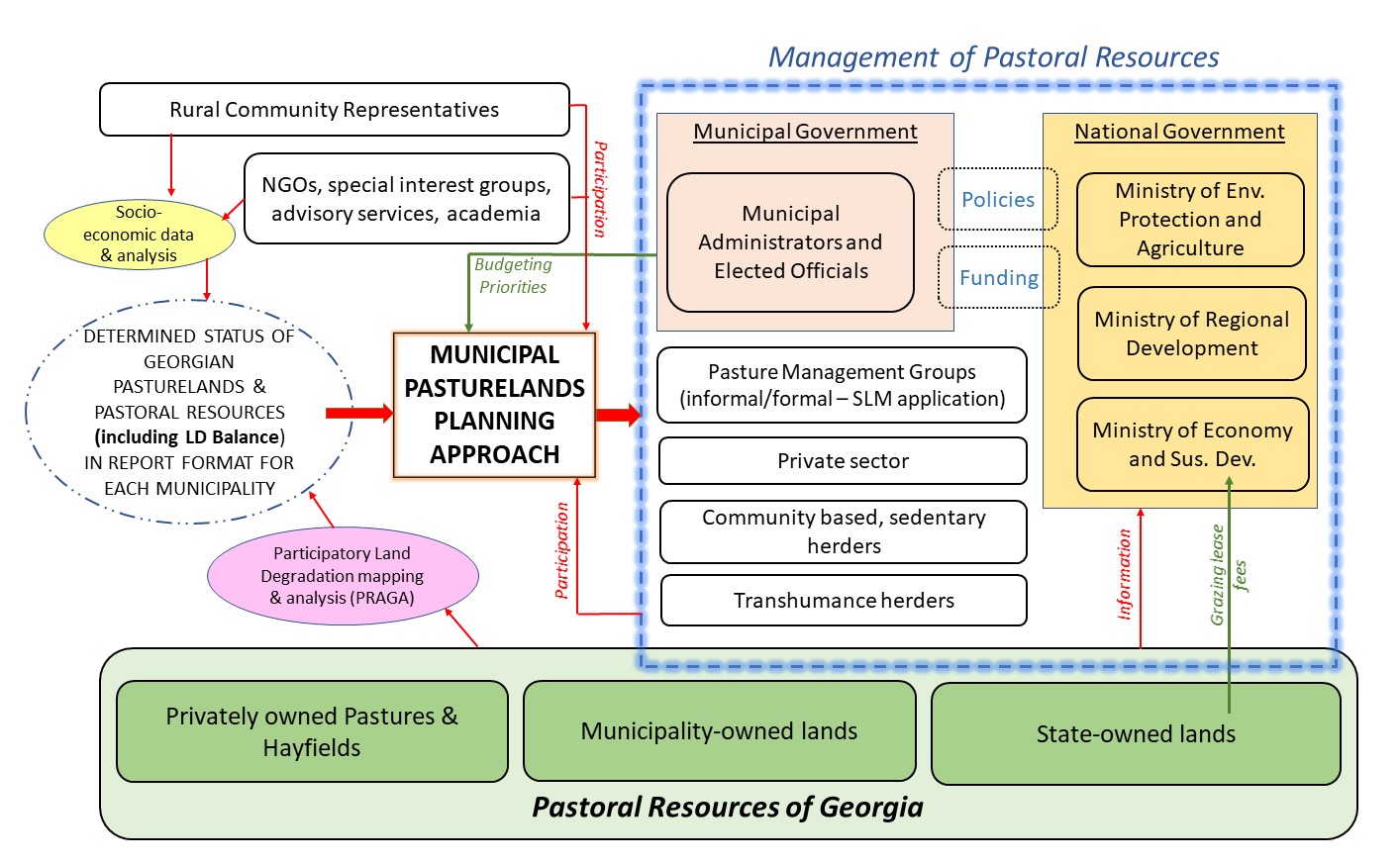
Description:
Diagram indicates information flows for those responsible for management of pastoral resources, monitoring and information feedback mechanisms and the stakeholders involved in the Municipal Pastureland Planning approach (Regional Environmental Centre for the Caucasus, 2025)
3.4 Prises de décision pour la sélection de la Technologie/ des Technologies
Indiquez qui a décidé de la sélection de la Technologie/ des Technologies à mettre en œuvre:
- tous les acteurs concernés dans le cadre d'une approche participative
Expliquez:
It is in everyone's interest to find the mechanisms by which grazing is improved and land degradation is addressed, so compromises must be found that meet the ecological needs of the site while allowing for land users to maintain their livelihoods. Agreements about seasonal grazing patterns and intensities can be hard to enforce so it is important to show the benefits and support proper grazing management with land user groups to ensure success.
Spécifiez sur quelle base ont été prises les décisions:
- l'évaluation de connaissances bien documentées en matière de GDT (prises de décision fondées sur des preuves tangibles)?
- les résultats de recherches?
- expériences et opinions personnelles (non documentées)
- Other GEF funded project results and lessons learned
4. Soutien technique, renforcement des capacités et gestion des connaissances
4.1 Renforcement des capacités/ formation
Une formation a-t-elle été dispensée aux exploitants des terres/ autres parties prenantes?
Oui
- Project partners, administrators and others community organisations and NGOs
Formats de la formation:
- sur le tas
- réunions publiques
- cours
Thèmes abordés:
The Status of Georgian Pasturelands; Activities of the GCP/GEO/006/GFF project; Methodology to develop Municipal scale pastureland plans; Methodology application and results; Validation of outcomes; Roles and Responsibilities for SLM and infrastructure development.
Commentaires:
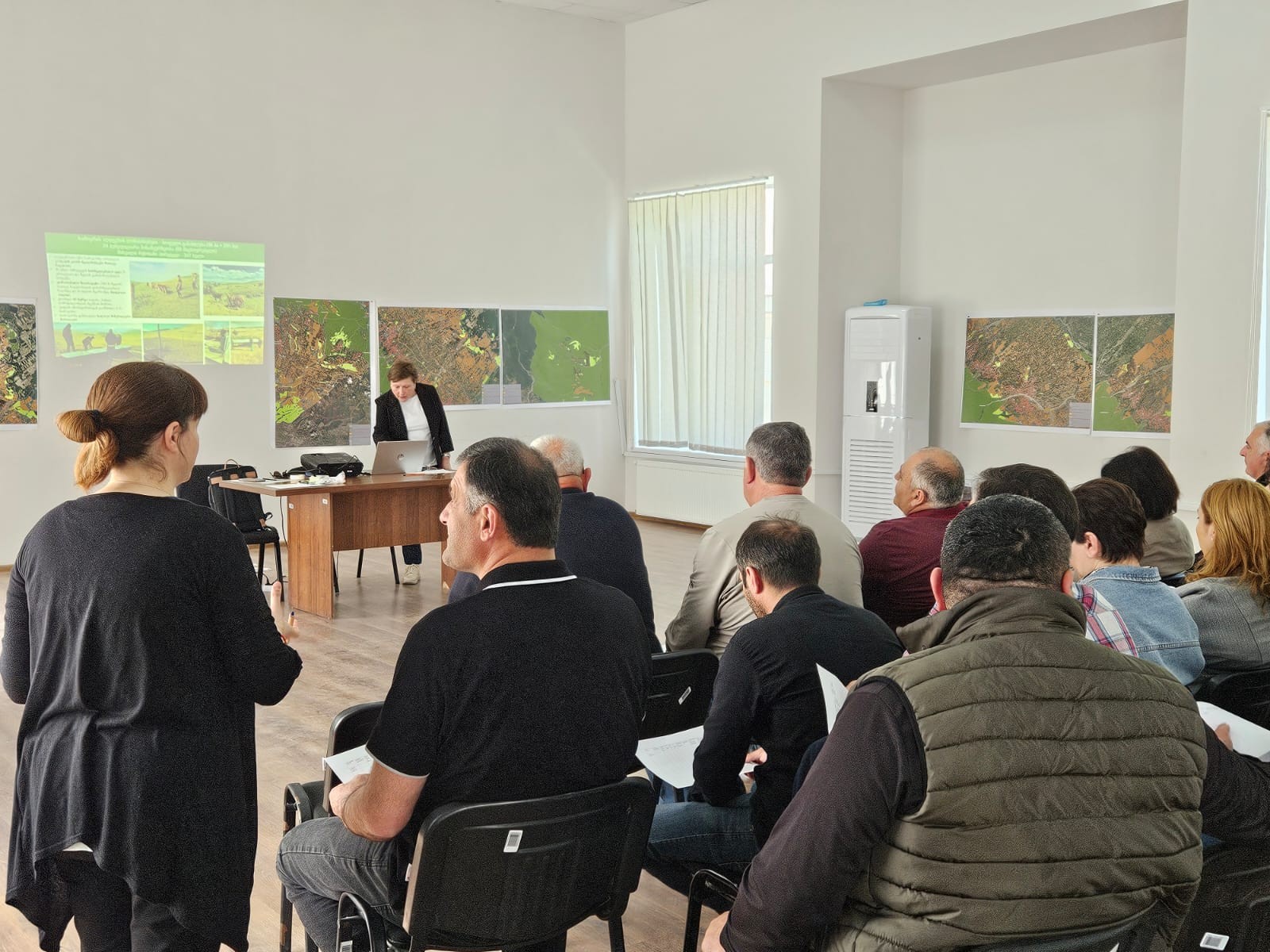
As part of the training, the manual for Municipal Pastureland Planning was presented and validated at national level. The resulting Municipal Pasturelands Management plans that came from the process were presented and validated at the local levels in all three target municipalities. Training on Pastureland management planning at municipal level was provided to the specialist of the National Agency of Land Sustainable Management and Land Use Monitoring.
4.2 Service de conseils
Les exploitants des terres ont-ils accès à un service de conseils?
Oui
Spécifiez si le service de conseils est fourni:
- dans des centres permanents
Décrivez/ commentez:
At the Municipal scale, the Ministry of Environmental Protection and Agriculture of Georgia and State Agency on Land Sustainable Management and Land Use monitoring (NASLM) would work with municipal administrators, providing data and technical expertise where required, while experts and municipal technicians would support with planning and application of technologies on the ground, precisely Controlled Grazing on pasturelands.
4.3 Renforcement des institutions (développement organisationnel)
Des institutions ont elles été mises en place ou renforcées par le biais de l'Approche?
- oui, beaucoup
Spécifiez à quel(s) niveau(x), ces institutions ont été renforcées ou mises en place:
- local
- national
Décrivez l'institution, ses rôles et responsabilités, ses membres, etc.
Institutional strengthening was supported mainly at national and municipal levels, as the National Agency for Sustainable Land Management and Land Use Monitoring (NASLM) and municipalities will be responsible for Pastures Use Planning upon adoption of the law.
Précisez le type de soutien:
- renforcement des capacités/ formation
- Data collection and analysis support
Donnez plus de détails:
Following recent policy developments, the NASLM is responsible for reporting on pastureland monitoring and land degradation, in close collaboration with Municipal authorities, the Protected Areas Agency (if there is protected areas in municipality within which grazing traditionally occurs), and other relevant agencies. Reporting will be based on data collected through the Participatory Rangeland and Grassland Assessment (PRAGA) methodology and other approved methodologies,
4.4 Suivi et évaluation
Le suivi et l'évaluation font ils partie de l'Approche? :
Non
Commentaires:
Monitoring and evaluation would be conducted through multiple channels. The Participatory Rangeland and Grassland Assessment (PRAGA) would serve as one important source of information for municipal planning discussions, alongside other relevant socio-economic and environmental data. The planning process itself provides a structured forum through which informed, community-based recommendations for the management of municipal grasslands can be presented, discussed, and refined.
4.5 Recherche
La recherche a-t-elle fait partie intégrante de l’Approche?
Non
5. Financement et soutien matériel externe
5.1 Budget annuel de la composante GDT de l'Approche
Si le budget annuel précis n'est pas connu, indiquez une fourchette:
- 2 000-10 000
Commentez (par ex. principales sources de financement/ principaux bailleurs de fonds):
The Municipal Pastureland Planning approach consists principally in communicating and hosting meetings, so it is not seen as a prohibitive cost. It is expected to coordinate diverse stakeholders into more cohesive grazing patterns and improve productivity of pastures which would benefit the municipal coffers if taxes on sales of livestock products were to increase. It therefore could be considered if done properly a 'wealth-generating expense', that could potentially be linked to changes in management through the land degradation maps and surveys.
5.2 Soutiens financiers/ matériels fournis aux exploitants des terres
Les exploitants des terres ont-ils reçu un soutien financier/ matériel pour la mise en œuvre de la Technologie/ des Technologies?
Non
5.3 Subventions pour des intrants spécifiques (incluant la main d'œuvre)
- aucun
5.4 Crédits
Des crédits ont-ils été alloués à travers l'Approche pour les activités de GDT?
Non
5.5 Autres incitations ou instruments
D'autres incitations ou instruments ont-ils été utilisés pour promouvoir la mise en œuvre des Technologies de GDT?
Oui
Si oui, spécifiez:
National Agency of State Property temporary (15 years) granted right of use of pilot pastures to the Dmanisi, Gurjaani and Kazbegi Municipalities given their involvement in the GCP/GEO/006/GFF project.
6. Analyses d'impact et conclusions
6.1 Impacts de l'Approche
Est-ce que l'Approche a autonomisé les exploitants locaux des terres, amélioré la participation des parties prenantes?
- Non
- Oui, un peu
- Oui, modérément
- Oui, beaucoup
It was in many respects the first time a coordinated effort was made to manage pastures at the municipal scale, and activities included participatory monitoring, capacity building and experimentation of alternative grazing approaches.
Est-ce que l'Approche a permis la prise de décisions fondées sur des données probantes?
- Non
- Oui, un peu
- Oui, modérément
- Oui, beaucoup
And did so across multiple scales. The approach integrated national and municipal level data with insights from participatory inputs and field surveys, creating a robust evidence base. The Municipal Pastureland Planning process then serves as a key forum for presenting this verified information, enabling informed decision-making on how best to invest in and sustain Georgia’s grasslands.
Est-ce que l'Approche a aidé les exploitants des terres à mettre en œuvre et entretenir les Technologies de GDT?
- Non
- Oui, un peu
- Oui, modérément
- Oui, beaucoup
While the approach can provide a list of potential LDN responses that would be recommended for different types of land degradation issues, it would be the responsibility of the land users to apply the technologies. The technology considered most appropriate in the case of the project was 'Controlled Grazing'.
Est-ce que l'Approche a amélioré la coordination et la mise en œuvre de la GDT selon un bon rapport coût-efficacité?
- Non
- Oui, un peu
- Oui, modérément
- Oui, beaucoup
The approach addresses pasture tenure and use rights by identifying common-use pasture areas within municipalities, thereby establishing a foundation for facilitating pasture use rights to local users. Special agreements between municipal administrations and local users’ unions will be concluded to regulate the use of common pastures, including provisions to ensure their sustainable management. Clarifying land tenure and use rights is a critical first step toward Sustainable Land Management (SLM), and the National Pastureland Management Policy Concept was developed in response to this fact. These efforts also meet UNCCD–FAO recommendations regarding Land Tenure issues which establish the importance of secure tenure arrangements in incentivising sustainable land use.
Est-ce que l'Approche a mobilisé/ amélioré l'accès aux ressources financières pour la mise en œuvre de la GDT?
- Non
- Oui, un peu
- Oui, modérément
- Oui, beaucoup
The municipal involvement with the project did allow for improved analysis of SLM practices and their implementation. The financial support from the project would be transferred to the Municipal administrations under the approach outlined here.
Est-ce que l'Approche a amélioré les connaissances et les capacités des exploitants des terres pour mettre en œuvre la GDT?
- Non
- Oui, un peu
- Oui, modérément
- Oui, beaucoup
The Municipal Pastureland Planning approach does not include training, capacity building, or other agricultural extension services for land users. Instead, it focuses on coordinating funding, on-the-ground management, and the implementation of sustainable land management (SLM) practices. Its primary aim is to provide a strategic framework and overview for addressing land degradation in pasturelands at the municipal level.
Est-ce que l'Approche a amélioré les connaissances et les capacités des autres parties prenantes?
- Non
- Oui, un peu
- Oui, modérément
- Oui, beaucoup
The participation of community-based organizations, NGOs, special interest groups, and municipal administrations brought diverse perspectives and objectives into the planning process. This inclusive approach helped surface varying needs and fostered mutual understanding among stakeholder groups. Training was also provided to NASLM specialists on the approach.
Est-ce que l'Approche a construit/ renforcé les institutions, la collaboration entre parties prenantes?
- Non
- Oui, un peu
- Oui, modérément
- Oui, beaucoup
The approach has strengthened institutional and stakeholder capacity to better understand the impacts of land degradation and assess the current ecological condition of various land cover types. It also creates a channel through which representatives of land users can communicate their observations and needs regarding local grasslands to municipal governments. This feedback can inform budget planning processes where feasible. On-the-ground collaboration may be further supported through Pasture User Groups or other informal associations and agreements, helping to coordinate sustainable land management (SLM) activities, particularly on pasturelands owned by the municipalities.
Est-ce que l'Approche a atténué les conflits?
- Non
- Oui, un peu
- Oui, modérément
- Oui, beaucoup
One of the objectives of the Pastures Use Planning at municipal level is to identify common use pastures, pastures for leasing, and the delineation of common use pastures to ensure a legal framework of access for local users. In this way, pasture use planning at a municipal level should greatly mitigate conflicts between land users and will improve issues of land tenure and therefore will support SLM.
Est-ce que l'Approche a autonomisé les groupes socialement et économiquement défavorisés?
- Non
- Oui, un peu
- Oui, modérément
- Oui, beaucoup
Herders and small-scale livestock producers in Georgia are often among the most socially and economically disadvantaged groups. Involving them in decisions about funding priorities for improving local pastoral resources and addressing land degradation is an empowering process. It not only ensures that their needs are reflected in planning but can also foster a stronger sense of ownership and belonging within rural communities.
Est-ce que l'Approche a amélioré l'égalité entre hommes et femmes et autonomisé les femmes et les filles?
- Non
- Oui, un peu
- Oui, modérément
- Oui, beaucoup
As with every GEF funded project, gender equality was well considered and incorporated into project activities and processes. The project worked with many different types of stakeholders and institutions and ensured a diverse representation at events and planning sessions.
Est-ce que l'Approche a encouragé les jeunes/ la prochaine génération d'exploitants des terres à s'engager dans la GDT?
- Non
- Oui, un peu
- Oui, modérément
- Oui, beaucoup
Yes, and mostly due to the increased accessibility and long term planning capacities that the approach brings to the table, as it streamlines land user needs with policy and budgetary planning, which is vital for investment and growth in rural areas, which in turn provides conditions for Georgia's youth to thrive in these communities.
Est-ce que l'Approche a amélioré les questions foncières et des droits d'utilisation qui entravent la mise en œuvre des Technologies?
- Non
- Oui, un peu
- Oui, modérément
- Oui, beaucoup
The Municipal Pastureland Planning approach will facilitate solutions to current pasture tenure/use rights issues by identifying pastures under common use at a municipal scale and will subsequently create an informed and legal basis for granting pasture use rights to local users. Clarified land tenure/use rights is the first step to SLM. Special agreements between municipalities administrations and local users unions will be concluded for use of the common use pasturelands, with the agreements including clear terms and mechanisms to ensure sustainable management of allocated pastures. The process aligns with the UNCCD-FAO guidelines on Land Tenure.
Est-ce que l'Approche a conduit à améliorer la sécurité alimentaire et/ou la nutrition?
- Non
- Oui, un peu
- Oui, modérément
- Oui, beaucoup
Introduction of SLM practices, such as Controlled Grazing, were seen to increase milk production of local cows and sheep accessing the pilot sites. This in turn led to improved nutrition for local rural households. The municipal planning process would indirect lead to these outcomes if properly done through addressing land degradation and increasing economic returns per ha of pastureland.
Est-ce que l'Approche a amélioré la capacité des exploitants des terres à s'adapter aux changements/ extrêmes climatiques et a atténué les catastrophes liées au climat?
- Non
- Oui, un peu
- Oui, modérément
- Oui, beaucoup
Improved pasture management that enhances vegetation cover and soil protection is a key climate change adaptation strategy. By maintaining permanent ground cover, healthy pastures reduce soil erosion, improve water retention, and buffer against extreme weather events such as droughts and floods (FAO, 2011). Practices such as rotational grazing, reseeding, and controlled stocking rates increase biomass productivity and soil organic carbon, thereby strengthening ecosystem resilience and supporting livelihoods under changing climate conditions (Smith et al., 2007; Thornton & Herrero, 2010). As such, sustainable pasture management not only restores degraded land but also helps communities adapt to the impacts of climate variability, maintaining livelihoods and increasing local market and industry opportunities.
Est-ce que l'Approche a conduit à des emplois, des opportunités de revenus?
- Non
- Oui, un peu
- Oui, modérément
- Oui, beaucoup
Improved pasture management led to increased milk production rates in the pilot areas the GCF/GEO/006/GFF project was active, which also improved household nutrition and income. Therefore, the scaling of SLM practices and contextually adapted interventions in areas where Land Degradation is or could be an issue is expected to increase pasture productivity, employment and income opportunities for rural municipal communities.
6.2 Principale motivation des exploitants des terres pour mettre en œuvre la GDT
- augmenter la production
- augmenter la rentabilité/ bénéfice, rapport coûts-bénéfices
- réduire la dégradation des terres
- réduire les risques de catastrophe
Reduced drought risk, improved water infiltration capacity of soils, more regulated and stable river and stream flows, reduction in surface runoff, improved river catchment function
- conscience environnementale
Georgians are very attached to their traditions and customs and their grasslands, pastures, steppes, alpine meadows and grazed lands are a vital component of the culture. This municipal planning process not only brings to light the current state of the country's pastures, but provides channels for information and informed decision-making to improve pastoral resource management.
- améliorer les connaissances et compétences en GDT
In areas where land degradation has been identified and funding or activities are planned through the Municipal Pastureland Planning process, sustainable land management (SLM) options would be introduced as part of an incentive-based approach, such as in exchange for investments in infrastructure or other forms of support.
- améliorer l'esthétique
Well managed pasturelands are aesthetically pleasing and are often protrayed as essential components of rural landscapes.
- atténuer les conflits
Clear and secure common-use land tenure for village pastures in Georgia reduces conflict by defining transparent rights and responsibilities among users. Legal clarity minimizes overlapping claims and disputes over grazing areas or boundaries. Participatory land-use planning reinforces this by involving communities in decisions that reflect local needs and traditional practices. Together, these measures promote fairness, trust, and cooperation, leading to more peaceful and sustainable pasture management. When SLM technologies are applied, we also expect to see greater pasture productivity and water availability through the reduction of bare ground and overgrazing.
6.3 Durabilité des activités de l'Approche
Les exploitants des terres peuvent-ils poursuivre ce qui a été mis en œuvre par le biais de l'Approche (sans soutien extérieur)?
- oui
Si oui, décrivez de quelle manière:
Yes, because the municipal planning process and changes in land tenure policies allows municipalities to permit community access to pasturelands granted they introduce SLM practices, and baseline maps and plans have now been jointly created with land users, which in itself provides a basis of understanding and continuity. In addition, the approach outlined here will soon be enshrined in the forthcoming Law on Pasture Management, ensuring sustainability and practice at least in the short to mid term.
6.4 Points forts/ avantages de l'Approche
| Points forts/ avantages/ possibilités du point de vue de l'exploitant des terres |
|---|
| The Municipal Pastureland Planning process allows for the capacity of land users to communicate to Municipal and potentially National administrators their observations and needs in terms of pastureland management and health. |
| It offers a mechanism for setting priorities in funding and investment, communicating to land users that economic constraints are a reality for public administrations. At the same time, it enables local communities to see how their voices and input can influence decisions and contribute to the development of more productive and well-managed landscapes. |
| The planning process also presents the findings of the PRAGA assessments on the condition and health of pastures at the municipal scale, informing communities and their representatives about the most degraded areas and those at risk. This offers them a clear overview of how local land management practices affect the municipality as a whole. |
| Points forts/ avantages/ possibilités du point de vue du compilateur ou d'une autre personne ressource clé |
|---|
| The health and productivity of the pastures and grasslands of the municipality is addressed as a whole, providing a clear picture for participants and raising awareness of the impacts of land degradation to specific landscapes and communities. It also would show evolution and trends over time as the yearly monitoring cycles of PRAGA were incorporated and presented to the group. These trends and evolution could be linked to management and solutions could be found to lift productivity and pasture health. |
| In accordance with the draft law aligned with the National Pastureland Management Policy Concept, municipal pastureland management plans will be adopted by both municipal and central government authorities, providing legal basis for common-use management and tenure, as well as monitoring systems to ensure sustainable land use. These municipal pasture management plans are also expected to serve as a foundation for budget planning at both central and local levels, establishing clear mechanisms for information sharing, funding allocation, and policy at all governmental levels in order to address degradation and loss of pastoral resources and heritage. |
| While the results of the planning process are not binding and do not impose funding requirements onto Municipal administrations, the process is an excellent means to capture what land users see as their priorities for investment for community pastures and livestock infrastructure. These investments could have a potentially generate strong economic returns given that increased pasture productivity has been shown to improve household nutrition, income and marketing opportunities. |
| Pastures and grasslands cover approximately 1.7 to 1.9 million hectares of Georgia, around 25% of the country’s total land area, and comprise about 50% of its agricultural land. However, there are currently no established forums or mechanisms to bring together stakeholders on a regular basis to discuss the condition and future of these resources. Likewise, solutions to land degradation and mismanagement, including sustainable land management (SLM) practices, are not being developed or implemented through a collaborative, cohesive approach at the scales needed. This Municipal Pastureland Planning process would be such a forum and mechanism for improved management at a municipal scale. |
6.5 Faiblesses/ inconvénients de l'Approche et moyens de les surmonter
| Faiblesses/ inconvénients/ risques du point de vue de l’exploitant des terres | Comment peuvent-ils être surmontés? |
|---|---|
| Not all land users can participate in the municipal scale planning process. | Proper identification of community based organisations or groups is essential and in some cases, groups who speak for land users about pastures may need to be created, i.e. Pasture User Groups |
| There is so much that needs attention and no one is willing to pay for interventions or solutions. | Incentivising proper management and pasture works and investment will require more formalised management and decision making structures than currently exist. Many times, the resources needed to implement SLM are already available in the communities so finding the right incentives to mobilise time, labour and investment through a formalised organisation. |
| People are invested in their current mindset and land management structures and revert back to their old ways once project or municipal funding stops. | Tackling land management issues and degradation can be addressed at scale through participatory planning process that value land user opinion and recommendations. Success stories and pilot lessons learnt need to be shared and communities need to be supported in the transition to more collaborative, coordinated grazing approaches that provide for more pasture productivity and wildlife/habitat conservation and alignment with Georgia's 5 LDN National targets. |
| Faiblesses/ inconvénients/ risques du point de vue du compilateur ou d'une autre personne ressource clé | Comment peuvent-ils être surmontés? |
|---|---|
| Both the Municipal and Central (MEPA/NASLM) governments need to organise, lead and demonstrate that the results of the Municipal Pastureland Planning process were taken into consideration in the municipal budgeting procedure. | While benefits to the municipal planning process are clear, they also require investment and efforts on part of the municipal government. Showcasing success stories and potential economic benefits of such a planning process directly to municipal authorities might be the best route to encourage adoption of this approach. |
| All land users and communities will try to prioritise investments in their areas at the expense of highly degraded sites. | This is where the findings from the PRAGA reports and maps will be essential, as well as application of the LDN Conceptual Framework and the LDN response hierarchy which allows for more stable and utilised lands to be addressed first. These provide clear indications of the extent and intensity of land degradation which should guide decision making. Well prepared, experienced facilitator is also a necessity for a successful planning process and result. |
| Well prepared meetings and experienced facilitators are vital to success. | The scope and scale of the planning process will bring to light many underlying issues and tensions; it is very possible the meeting will hear frustrations and outburst. However, the scale and importance of pasture and grazing lands in the Georgian economy necessitates informed decision making and action to ensure this resource is well managed and available to future generations. |
| Obtaining highly accurate data on the spatial distribution of pasturelands within municipalities, their actual use by local communities or transhumance herders, and precise reporting of livestock numbers grazing these pastures will be challenging. | Pastures Identification and official registration in public register (that is required by the policy concept and draft law) will be first step to obtain accurate maps on pasturelands spatial distribution. The ongoing programme National Animal Identification and Traceability System in Georgia (NAITS) will support identification of livestock numbers by villages and allow for identification and allocation of the common use pastures within the municipality. |
| Success of the planning process requires the central and municipal governments have a clear vision of the criteria for identifying common-use pastures. | Much of the criteria has been established through the work of the project partners and presented in the National Pastureland Management Policy Concept, though they will require consistent review and policy reform once the pasture law comes into effect. |
| The planning process itself will be complex and lengthy, and a successful outcome will require good organization and strong facilitation by both central and local governments. | A clear facilitation role and lead entity will need to be identified that has sufficient capacity and mandate to implement the Municipal Pastureland Planning approach. The NASLM has been tasked with this responsibility. |
7. Références et liens
7.1 Méthodes/ sources d'information
7.2 Références des publications disponibles
Titre, auteur, année, ISBN:
Governing the Commons: The Evolution of Institutions for Collective Action. Ostrom, Elinor (1990). Cambridge, UK: Cambridge University Press. ISBN 978-0521405997
Disponible à partir d'où? Coût?
https://archive.org/
Titre, auteur, année, ISBN:
Ecologically Based Municipal Land Use Planning. William B. Honachefsky (2000). CRC Press. ISBN: 9781566703744
Disponible à partir d'où? Coût?
https://www.taylorfrancis.com/books/mono/10.1201/9780203758960/ecologically-based-municipal-land-use-planning-william-honachefsky
Titre, auteur, année, ISBN:
Planning the Uses and Management of Land (Agronomy Monograph 21). Marvin T. Beatty, Gary W. Petersen, Leslie D. Swindale (1987). American Society of Agronomy. ISBN: 9780891180895
Disponible à partir d'où? Coût?
https://acsess.onlinelibrary.wiley.com/doi/book/10.2134/agronmonogr21
Titre, auteur, année, ISBN:
Holistic Management: A Commonsense Revolution to Restore Our Environment. Allan Savory & Jody Butterfield (2016). Island Press, USA. 978‑1‑61091‑743‑8
Disponible à partir d'où? Coût?
https://savory.shop/collections/books
7.3 Liens vers les informations pertinentes disponibles en ligne
Titre/ description:
The scientific conceptual framework for Land Degradation Neutrality (LDN)
URL:
https://www.unccd.int/sites/default/files/documents/2019-06/LDN_CF_report_web-english.pdf
Titre/ description:
Land Use Planning for Land Degradation Neutrality: Reflections and Critical Challenges
URL:
https://www.researchgate.net/publication/387869379_Land_Use_Planning_for_Land_Degradation_Neutrality_Reflections_and_Critical_Challenges
Titre/ description:
Achieving land degradation neutrality: land-use planning and ecosystem approach
URL:
https://www.frontiersin.org/journals/environmental-science/articles/10.3389/fenvs.2024.1446056/full
Titre/ description:
Ministry of Environment Protection and Agriculture of Georgia Collaborates with Regional Administrations to Discuss the Concept of National Policy for Sustainable Pasture Management
URL:
https://land.gov.ge/En/Public-relations/News/55
Liens et modules
Développer tout Réduire toutLiens
Controlled Grazing [Géorgie]
“Controlled Grazing” seeks to harness the behaviours and habits of ruminant livestock to enhance three key ecological functions, namely the removal of plant biomass (grazing), soil and vegetation disturbance (animal impact) and increased nutrient cycling (dung and urine), with the goal of increasing perennial grass establishment, pasture palatability and reducing …
- Compilateur : Nicholas Euan Sharpe
Modules
Aucun module trouvé