

Participatory Net Planning for Sustainable Watershed Management [Inde]
- Création :
- Mise à jour :
- Compilateur : Arun Bhagat
- Rédacteur : –
- Examinateur : Udo Höggel
Participatory Net Planning – A tool that involves stakeholders in planning, developing, and managing their land and natural resources
approaches_7651 - Inde
Voir les sections
Développer tout Réduire tout1. Informations générales
1.2 Coordonnées des personnes-ressources et des institutions impliquées dans l'évaluation et la documentation de l'Approche
Personne(s) ressource(s) clé(s)
Spécialiste GDT:
Kalaskar Prashant
+91 9403961586
prashant.kalaskar@wotr.org.in
Watershed Organisation Trust (WOTR), Pune
Watershed Organisation Trust (WOTR), Gitai, 1st Floor, New Nagar Road, Sangamner – 422605, Dist. Ahmednagar, Maharashtra, India
Inde
Spécialiste GDT:
D’Souza Marcella
+91 9422226415
marcella.dsouza@gmail.com
W-CReS (the WOTR Centre for Resilience Studies), Watershed Organisation Trust (WOTR), Pune
The Forum, 2nd Floor, Pune - Satara Rd, above Ranka Jewellers, Padmavati Nagar, Corner, Pune, Maharashtra 411009 (India)
Inde
Spécialiste GDT:
Spécialiste GDT:
Solanky Vijay
+91 8824144388
vijay.solanky@wotr.org.in
W-CReS (the WOTR Centre for Resilience Studies), Watershed Organisation Trust (WOTR), Pune
The Forum, 2nd Floor, Pune - Satara Rd, above Ranka Jewellers, Padmavati Nagar, Corner, Pune, Maharashtra 411009 (India)
Inde
Nom du projet qui a facilité la documentation/ l'évaluation de l'Approche (si pertinent)
Applying Landscape and Sustainable Land Management (L-SLM) for mitigating land degradation and contributing to poverty reduction in rural area (L-SLM Project)Nom du ou des institutions qui ont facilité la documentation/ l'évaluation de l'Approche (si pertinent)
Watershed Organisation Trust (WOTR) - Inde1.3 Conditions relatives à l'utilisation par WOCAT des données documentées
Quand les données ont-elles été compilées (sur le terrain)?
18/09/2025
Le compilateur et la(les) personne(s) ressource(s) acceptent les conditions relatives à l'utilisation par WOCAT des données documentées:
Oui
2. Description de l'Approche de GDT
2.1 Courte description de l'Approche
Participatory Net Planning (PNP) is a practical methodology that actively engages landowners and local stakeholders in planning and implementing measures for land use, soil conservation, water harvesting, and biomass development. It aims to regenerate ecosystems and improve the sustainability of watersheds through site-specific resource management. PNP emphasizes the conservation, productivity enhancement, and sustainable use of natural and biological resources. It involves assessing the current condition and use of land, water, and vegetation, and preparing detailed plans—with estimated costs and timelines—to achieve the desired outcomes.
In Participatory Net Planning (PNP), the term “Net” represents a complete and interconnected planning framework where every land parcel within a watershed is individually assessed and linked to the larger watershed system. It highlights a network-based approach that integrates soil, water, vegetation, and community needs, ensuring that interventions on one farm support resource conservation and productivity across neighboring and downstream lands. Overall, it signifies a holistic and coordinated system where all stakeholders and resources are planned collectively for sustainable and long-term watershed management.
2.2 Description détaillée de l'Approche
Description détaillée de l'Approche:
By design, PNP functions as a tool for mobilization, training, monitoring, and evaluation in watershed programs.
Its key objectives are:
•Building ownership and commitment among landowners and stakeholders to ensure the long-term sustainability of watershed interventions.
•Planning site-specific measures that meet local needs, improve productivity, and address resource challenges.
•Developing realistic plans with clear activities, budgets, and timelines that can be implemented effectively, minimizing gaps between planned and actual outcomes.
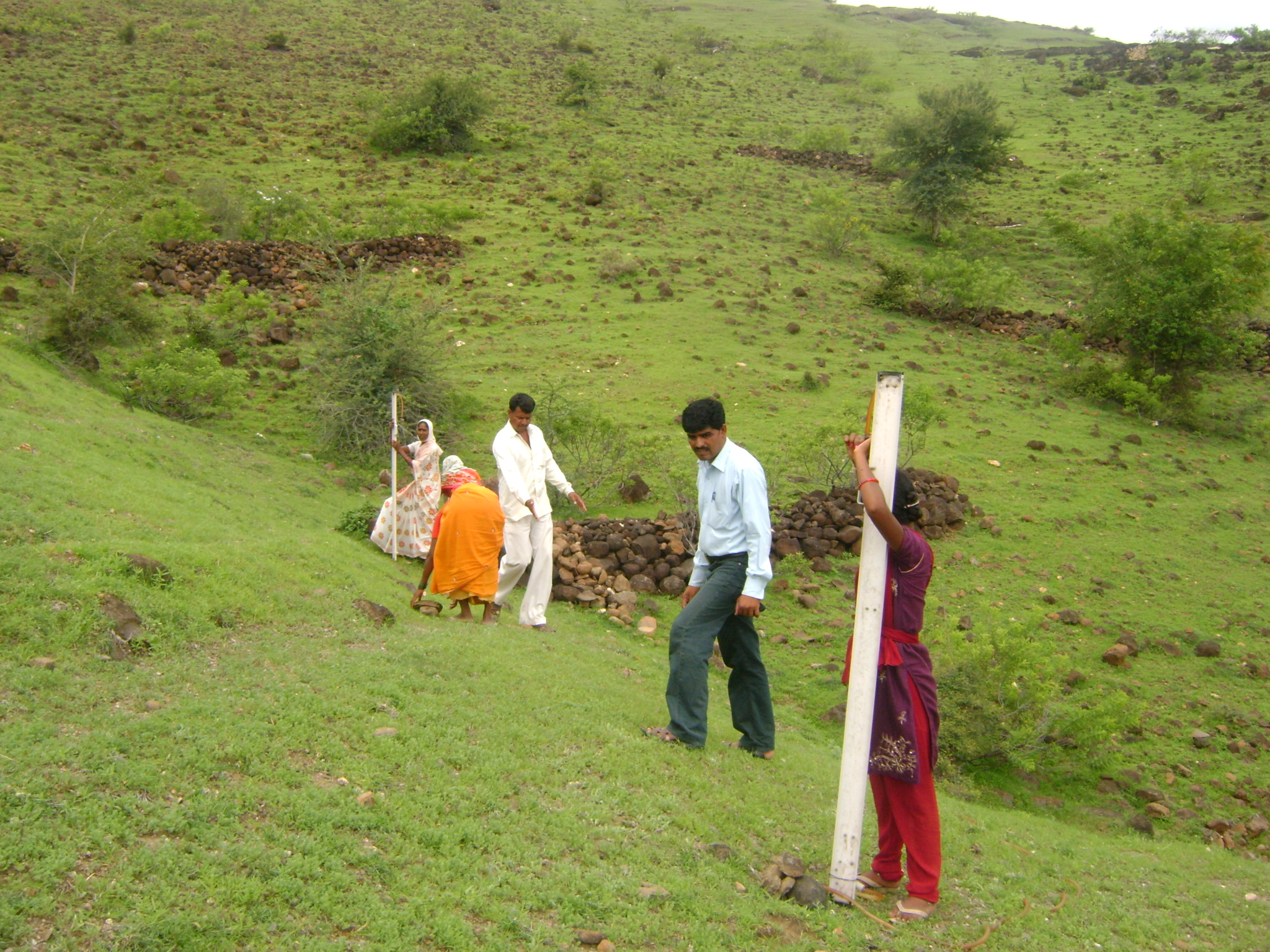
The PNP approach places stakeholders at the center of the process. Landowners, farmers (both men and women), or users of Common Property Resources (CPRs) are directly involved in decision-making for their land or shared resources. During PNP exercises, the planning team visits each landholding or CPR along with the concerned stakeholders to jointly survey, assess, and plan interventions.
Stakeholders share their views on current and proposed land use and the necessary soil and water conservation treatments. The team discusses best practices and scientific options for land management, explaining their benefits and suitability. The final decision on interventions rests with the stakeholder—except when proposed actions could harm neighboring lands, CPRs, or the environment. In such cases, efforts are made to reach a consensus; if not possible, treatments on that land are withheld.
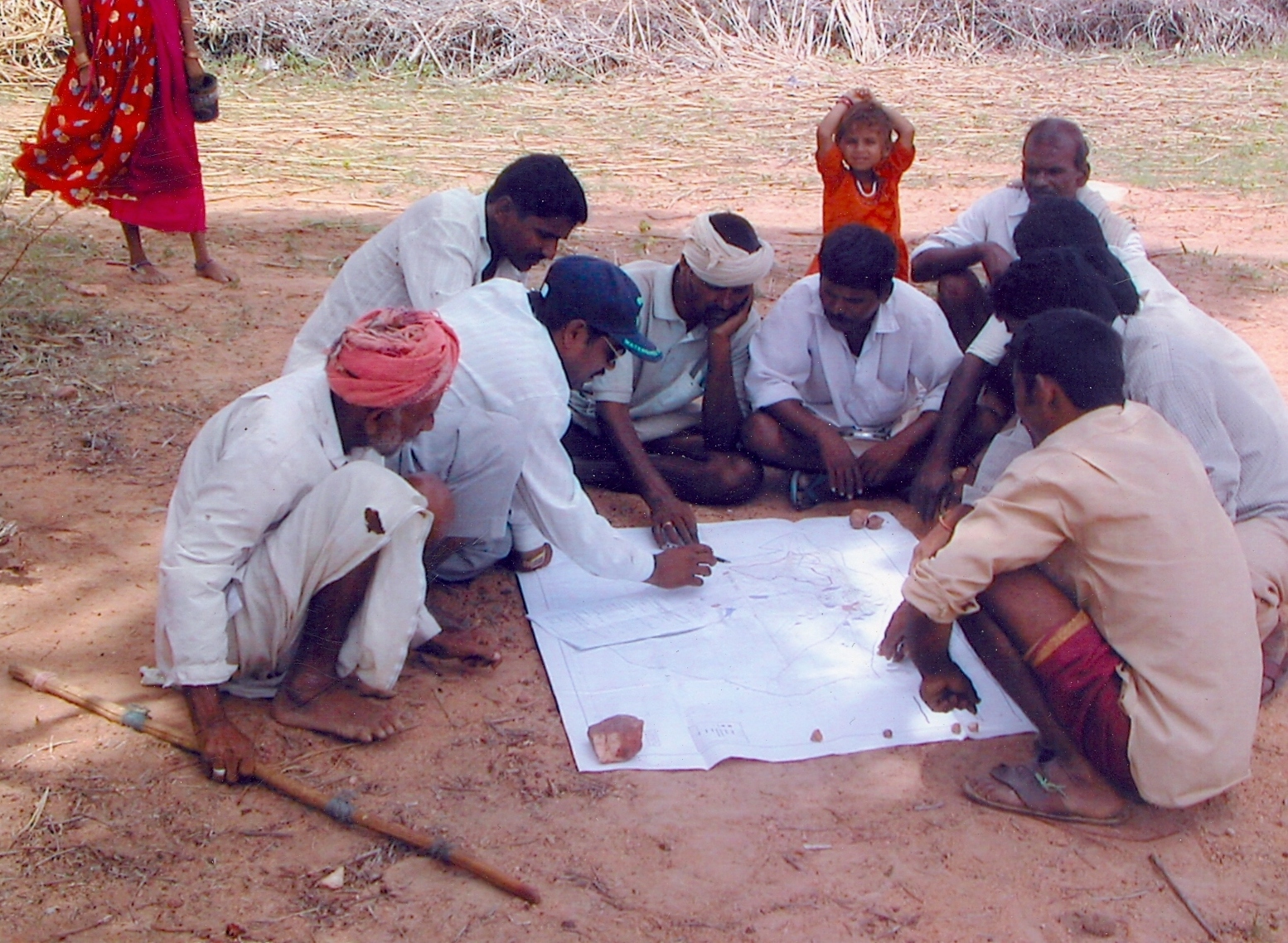
Once agreement is reached, the proposed measures are documented in writing and mapped on a diagram of the land or CPR.
PNP is gender-inclusive, ensuring both men and women participate in planning and decision-making. Ideally, the farming couple or land-owning couple is present during planning, even when land is officially registered in the man’s name. For CPRs, where stakeholders include landless people, marginal farmers, livestock owners, and shepherd communities, institutions like the Village Watershed Committee (VWC), Village Development Committee (VDC), and Gram Panchayat (GP) are involved. Their role is to ensure equitable access to ressources, manage conflicts, and establish transparent and representative local institutions for sustainable management of CPRs and create assets.
The Participatory Net Plan is more than just a planning document—it serves as a blueprint for implementation. Written in the local language, it remains accessible to stakeholders for regular reference. The plan is flexible and adaptive, evolving as new information emerges or stakeholders revise their preferences. Thus, it acts as a “living document” that supports transparency, continuous monitoring, and accountability.
2.3 Photos de l'approche
Galerie Médias
Remarques générales concernant les photos:
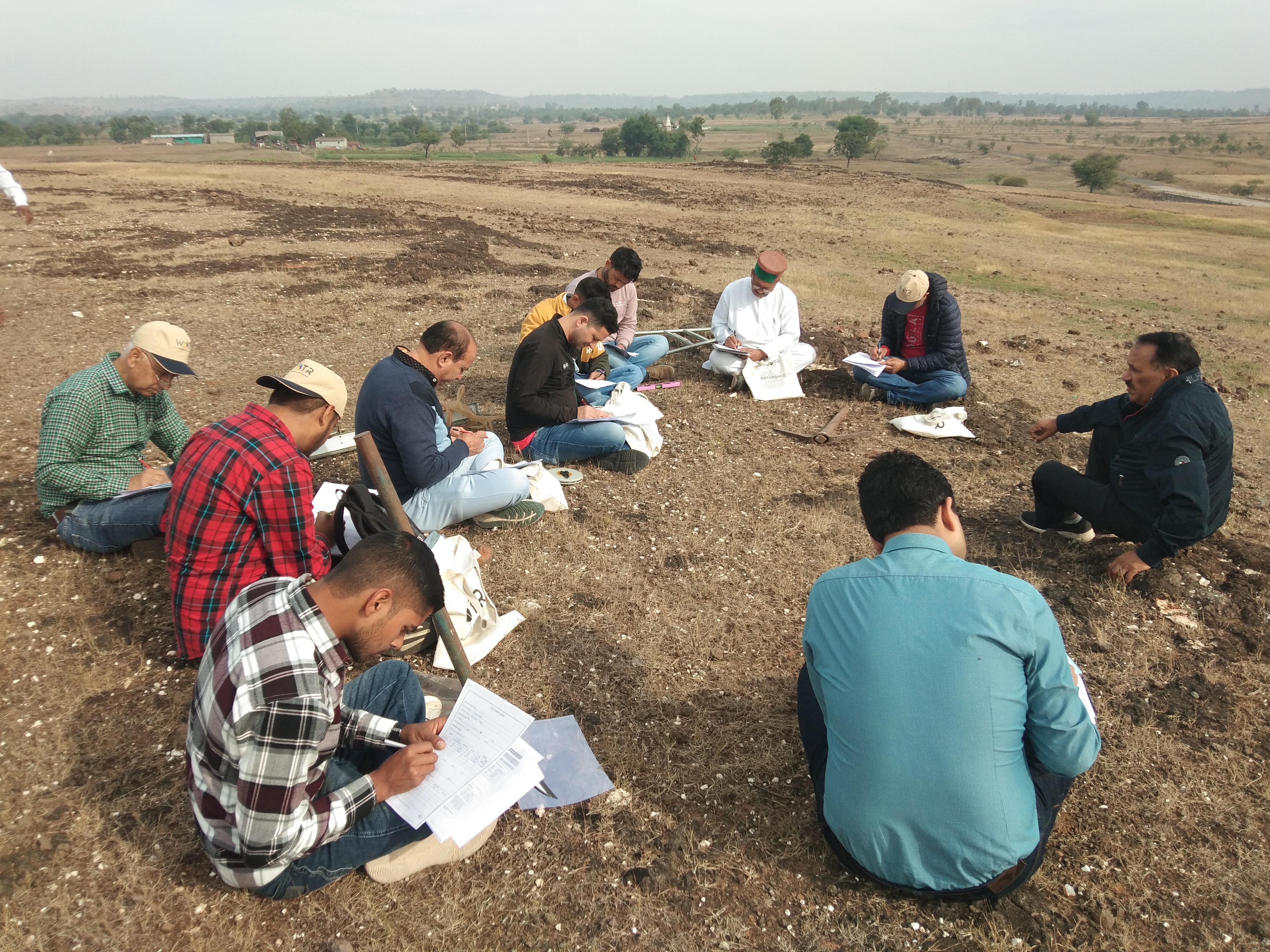
The photos capture active community participation, field discussions, and collaborative decision-making between farmers and experts during the PNP process, reflecting practical learning and collective planning for sustainable land management.
2.5 Pays/ région/ lieux où l'Approche a été appliquée
Pays:
Inde
Région/ Etat/ Province:
Maharashtra
Autres spécifications du lieu :
Darewadi,Post. Kauthe Malkapur, Taluka Sangamner, Dist. Ahilyanagar,
Commentaires:
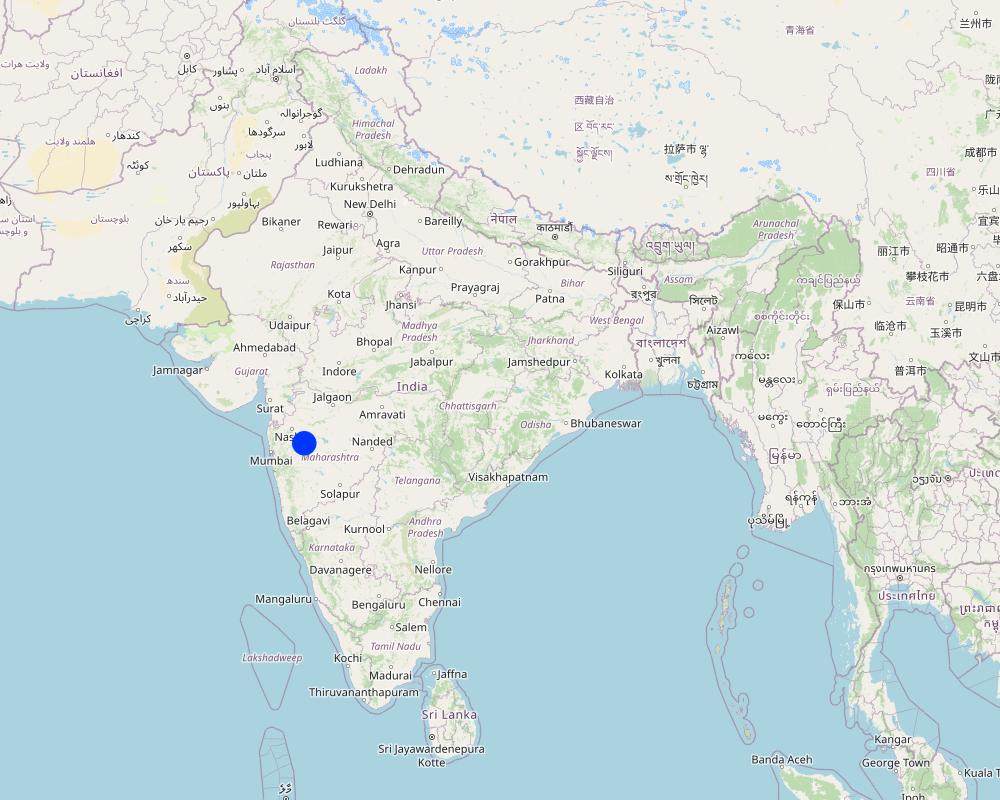
The Participatory Net Planning (PNP) approach was first implemented in Darewadi village, located in Kauthe Malkapur post, Sangamner taluka, Ahilyanagar district, Maharashtra, India.
Map
×2.6 Dates de début et de fin de l'Approche
Indiquez l'année de démarrage:
1995
2.7 Type d'Approche
- fondé sur un projet/ programme
2.8 Principaux objectifs de l'Approche
The main objectives of Participatory Net Planning (PNP) are:
•To build a sense of ownership and commitment among landowners and other stakeholders within a watershed, ensuring long-term sustainability of the implemented measures.
•To plan site-specific interventions, meet stakeholder needs, and enhance land and water productivity.
•To develop practical proposals with clear activities, budgets, and timelines that ensure planned measures are effectively implemented and easily scaled up.
2.9 Conditions favorisant ou entravant la mise en œuvre de la(des) Technologie(s) appliquée(s) sous l'Approche
normes et valeurs sociales/ culturelles/ religieuses
- favorise
Strong local bonding, traditional mutual-help systems (e.g., shramdaan), and trust in community leadership support smooth mobilization, joint action, and quick adoption of land and water measures.
- entrave
Social hierarchies, reluctance to change established practices, or participation limited to men may exclude key decision-makers, reducing inclusiveness and impact.
disponibilité/ accès aux ressources et services financiers
- favorise
Availability of subsidies, project funds, bank credit, and SHG financing allows farmers to adopt technologies like bunding, trenching, or water harvesting without major financial stress.
- entrave
High upfront costs, inadequate financial literacy, and slow fund release discourage participation and may lead to incomplete works.
cadre institutionnel
- favorise
Strong and well-functioning institutions (VDC, GP, watershed committees) ensure better planning, dispute resolution, and accountability, increasing project success.
- entrave
Weak institutions and lack of leadership create delays, communication gaps, and poor transparency in decision-making.
collaboration/ coordination des acteurs
- favorise
Active support from multiple actors — technical experts, government departments, and villagers — promotes effective knowledge exchange and faster implementation.
- entrave
Misalignment in roles, unclear responsibilities, or lack of coordination slows progress and reduces effectiveness of interventions.
cadre juridique (régime foncier, droits d'utilisation des terres et de l'eau)
- favorise
Clear land ownership provides confidence for farmers to invest in long-term land improvement practices since they benefit directly from gains.
- entrave
Disputed titles, tenancy issues, or unclear CPR access rights delay planning and restrict work, especially on shared lands.
cadre politique
- favorise
Supportive agricultural, watershed, and rural development policies provide strong institutional backing, technical support, and long-term vision.
- entrave
Frequent changes in guidelines, budget cuts, or administrative barriers disrupt continuity in planning and execution.
gouvernance foncière (prise de décisions, mise en œuvre et application des décisions)
- favorise
Fair and transparent governance ensures equal benefits, compliance with planned measures, and responsible use of natural resources.
- entrave
Ineffective enforcement or favoritism creates distrust, conflicts, and irregular implementation outcomes.
connaissances sur la GDT, accès aux supports techniques
- favorise
Farmer training, exposure visits, and expert guidance improve understanding of benefits, correct design, and maintenance of SWC structures.
- entrave
Limited technical support results in poor-quality structures and reduced confidence among farmers.
marchés (pour acheter les intrants, vendre les produits) et prix
- favorise
Ready access to markets motivates farmers to adopt improved land use and productivity-enhancing measures since profits increase.
- entrave
Price volatility and distant markets reduce economic incentives for adopting new technologies or crop diversification.
charge de travail, disponibilité de la main-d'œuvre
- favorise
Local labor availability and farmer involvement ensure timely execution, especially before monsoon when structures are most effective.
- entrave
Rural migration and labor shortages lead to delays, rushed construction, or higher labor costs.
autre
- favorise
Climate and weather conditions:
Normal rainfall ensures proper functioning of trenches, bunds, and vegetation growth, validating the benefits of interventions.
- entrave
Climate and weather conditions:
Droughts, heavy storms, or irregular monsoons cause structure damage or reduced productivity, lowering adoption enthusiasm.
autre
- favorise
Accessibility & terrain:
Good road connectivity ensures smooth movement of tools, equipment, and produce; reduces cost and effort.
- entrave
Accessibility & terrain:
Difficult terrain and remote locations increase logistics challenges, delaying technology application and maintenance.
3. Participation et rôles des parties prenantes impliquées dans l'Approche
3.1 Parties prenantes impliquées dans l'Approche et rôles
- exploitants locaux des terres / communautés locales
Farmers, landowners, women's (Self-help Group (SHG)), members, livestock owners
Main decision-makers: provide land-related information; participate in planning, implementation, maintenance, and long-term management.
- organisations communautaires
Village Development Committee (VDC), Village Watershed Committee (VWC), Gram Sabha, SHGs
Mobilize participation, ensure equity and conflict resolution, coordinate between community and experts, support monitoring and governance.
- Spécialistes de la GDT/ conseillers agricoles
Agricultural engineers, watershed technicians, extension workers, soil experts
Provide technical guidance for soil and water conservation measures, land classification, crop planning, and best practices during planning and execution.
- chercheurs
Agricultural Universities, Central Agriculture Institutes, Watershed Research Organizations
Support scientific assessment, innovations, and evaluation of interventions; document learnings for improvement and scaling up.
- enseignants/ élèves/ étudiants
Local schools, eco-clubs
Raise awareness on conservation practices; promote environmental stewardship and behavioral change.
- ONG
e.g., WOTR (Watershed Organisation Trust) or similar implementing agencies
Lead mobilization, capacity building, technical support, process facilitation, documentation, and convergence with schemes.
- secteur privé
Input suppliers, equipment providers, contractors, Farmers Producer Organisations (FPOs)
Provide materials, machinery, and technical services; help improve market linkages for agricultural produce.
- gouvernement local
Gram Panchayat, Block Agriculture Office, Rural Development staff
Administrative approvals, fund management, land governance, support convergence of government programs.
- gouvernement national (planificateurs, décideurs)
Ministry of Rural Development, Department of Agriculture & Land Resources
Policy framework, program funding, national guidelines, evaluation, scaling successful models.
- organisation internationale
Funding and technical partners (e.g., UNCCD initiatives)
Provide funding, advanced training, exposure to global best practices, and knowledge sharing.
Si plusieurs parties prenantes sont impliquées, indiquez l'organisme chef de file ou l'institution responsable:
The main implementation agency (e.g., NGO like WOTR or a government watershed department) acts as the lead stakeholder, coordinating planning, execution, and monitoring across all actors.
3.2 Participation des exploitants locaux des terres/ communautés locales aux différentes phases de l'Approche
| Participation des exploitants locaux des terres/ communautés locales | Spécifiez qui était impliqué et décrivez les activités | |
|---|---|---|
| initiation/ motivation | interactive | Local people are involved in awareness sessions, discussions, and joint problem analysis. Villagers, farmer groups, and watershed committees participate in identifying issues, priorities, and resources. |
| planification | interactive | Local communities participate in mapping land, resources, and existing interventions. They jointly develop action plans, decide on resource allocation, and may plan their own initiatives (self-mobilization). |
| mise en œuvre | interactive | Communities implement activities like soil and water conservation structures, plantations, or crop management. Some activities may be supported by food/cash/material incentives, but local ownership is emphasized. |
| suivi/ évaluation | interactive | Local groups participate in tracking progress, maintaining records, and providing feedback. Village committees and farmer groups jointly evaluate the success of interventions and suggest corrective measures. |
| Farmers and local knowledge | interactive | Farmers provide local knowledge, observations, and data for research purposes. They interact with external teams for documentation, experimentation, and knowledge sharing. |
3.3 Diagramme/ organigramme (si disponible)
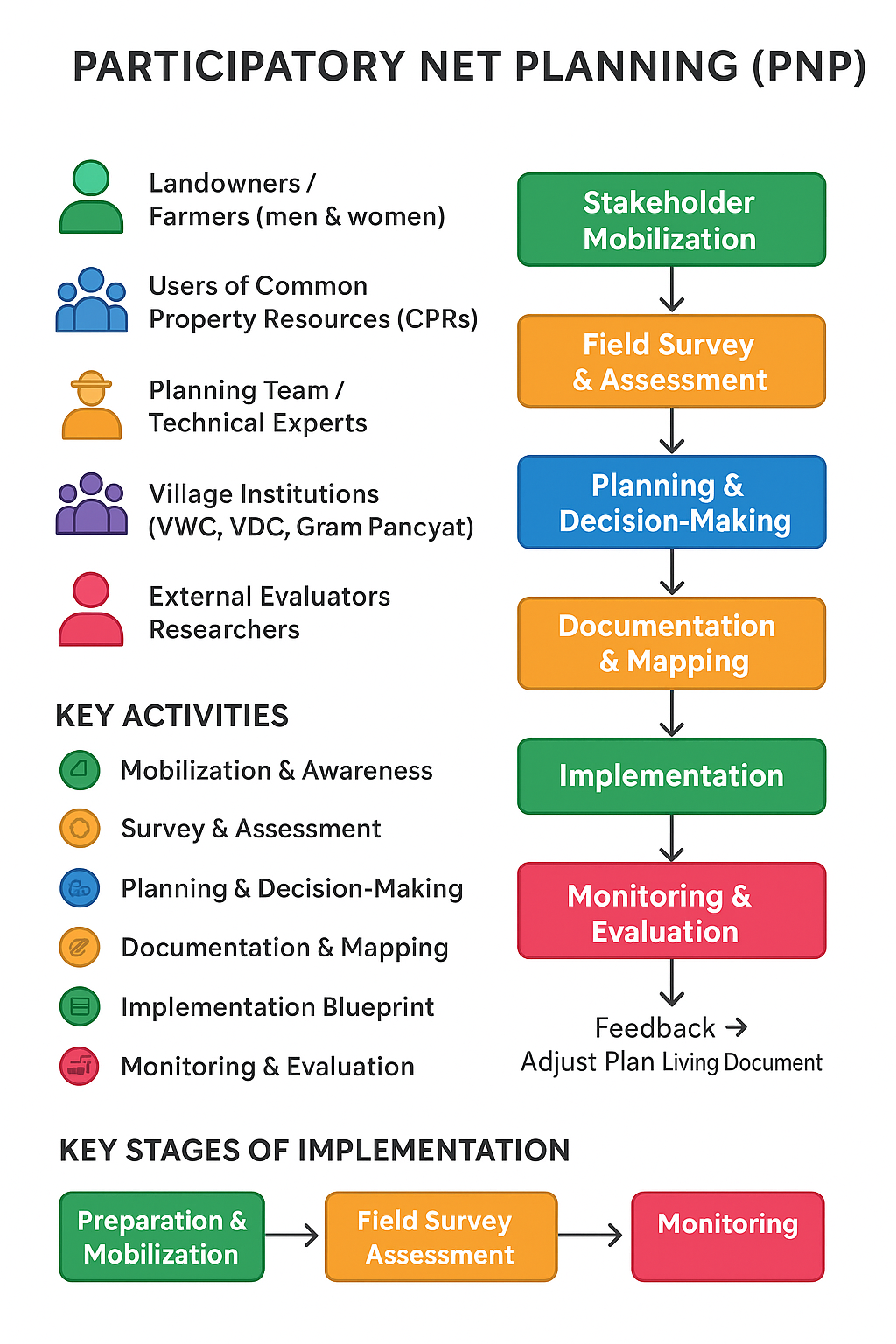
Description:
Flow chart:
The visual summary illustrates the key steps of the PNP approach
Community Mobilization:
Awareness meetings are organized to inform villagers about the purpose of Participatory Net Planning. Local institutions such as the Village Development Committee (VDC), Gram Panchayat (GP), and watershed committees motivate farmers and landowners to participate actively in the process.
Field Assessment:
The planning team, along with landowners and local experts, visits each plot or common property area to study land use, soil condition, slope, and water flow. Existing problems like erosion, poor drainage, or low productivity are identified and discussed on-site.
Participatory Planning:
Stakeholders, including both men and women farmers, jointly decide on the best soil and water conservation measures. Technical experts suggest suitable scientific options, and a consensus is built on feasible and sustainable interventions tailored to each landholding.
Documentation & Implementation:
The agreed plan is documented in simple local language and mapped clearly for each farm or area. Resources such as labor, machinery, and materials are mobilized, and the works are executed under close supervision of technical experts and local committees.
Monitoring & Evaluation:
The progress and quality of work are jointly monitored by the technical team, village committees, and farmers. Periodic evaluations ensure the plan stays relevant, effective, and sustainable, encouraging learning, accountability, and continuous improvement.
Auteur:
Dr. Arun Bhagat
3.4 Prises de décision pour la sélection de la Technologie/ des Technologies
Indiquez qui a décidé de la sélection de la Technologie/ des Technologies à mettre en œuvre:
- tous les acteurs concernés dans le cadre d'une approche participative
Expliquez:
The PNP approach helps identify the current land use and understand the socio-economic conditions linked to it. It aims to improve farmers’ income by suggesting better land use patterns. Technical and agricultural experts play a key role in preparing the proposed land use plan, which is then replicated with other farmers in the village. The village committee is essential for mobilizing and encouraging community participation in this process.
Spécifiez sur quelle base ont été prises les décisions:
- l'évaluation de connaissances bien documentées en matière de GDT (prises de décision fondées sur des preuves tangibles)?
- expériences et opinions personnelles (non documentées)
4. Soutien technique, renforcement des capacités et gestion des connaissances
4.1 Renforcement des capacités/ formation
Une formation a-t-elle été dispensée aux exploitants des terres/ autres parties prenantes?
Oui
Spécifiez qui a été formé:
- exploitants des terres
- personnels/ conseillers de terrain
Formats de la formation:
- entre agriculteurs (d'exploitants à exploitants)
- zones de démonstration
- réunions publiques
Thèmes abordés:
Assessment of current land use, classification of land types, and implementation of on-site soil conservation measures.
Commentaires:
A joint meeting of multiple landowners is organized to share basic information, followed by a field demonstration in one of the plots to explain the planning tool. Photos and videos of various in-situ soil conservation measures, aligned with the land use and land cover, are also presented.
4.2 Service de conseils
Les exploitants des terres ont-ils accès à un service de conseils?
Oui
Spécifiez si le service de conseils est fourni:
- dans les champs des exploitants?
- dans des centres permanents
Décrivez/ commentez:
The service is provided under the project by the implementing agency. The landowner can develop the land according to requirements with the assistance of a land developer or consultant.
4.3 Renforcement des institutions (développement organisationnel)
Des institutions ont elles été mises en place ou renforcées par le biais de l'Approche?
- oui, beaucoup
Spécifiez à quel(s) niveau(x), ces institutions ont été renforcées ou mises en place:
- local
- régional
Décrivez l'institution, ses rôles et responsabilités, ses membres, etc.
The planning tool is a socio-technical approach used for sustainable land development. Agricultural engineers, social engineers, and environmental experts from institutions can participate, along with officers from the Forest and Agricultural departments.
Précisez le type de soutien:
- financier
- renforcement des capacités/ formation
4.4 Suivi et évaluation
Le suivi et l'évaluation font ils partie de l'Approche? :
Oui
Commentaires:
The overall plan is verified on a sample basis to ensure quality and alignment with ground reality.
Si oui, ce document est-il destiné à être utilisé pour le suivi et l'évaluation?
Oui
Commentaires:
Field verification shall be conducted based on the prepared planning documents.
4.5 Recherche
La recherche a-t-elle fait partie intégrante de l’Approche?
Oui
Spécifiez les thèmes:
- sociologie
- économie/ marketing
- écologie
- technologie
Donnez plus de détails et indiquez qui a mené ces recherches:
Experts involved in the planning and implementation of the PNP contribute their experience. While research was not the primary focus, insights gained during community mobilization and watershed plan execution help improve the approach for smoother implementation.
5. Financement et soutien matériel externe
5.1 Budget annuel de la composante GDT de l'Approche
Si le budget annuel précis n'est pas connu, indiquez une fourchette:
- < 2 000
Commentez (par ex. principales sources de financement/ principaux bailleurs de fonds):
The total cost from planning to implementation is measured per hectare and ranges from ₹20,000 to ₹50,000 per hectare, depending on the proposed land use.
5.2 Soutiens financiers/ matériels fournis aux exploitants des terres
Les exploitants des terres ont-ils reçu un soutien financier/ matériel pour la mise en œuvre de la Technologie/ des Technologies?
Oui
5.3 Subventions pour des intrants spécifiques (incluant la main d'œuvre)
- aucun
Si la main d'œuvre fournie par les exploitants des terres était un intrant substantiel, elle était:
- volontaire
5.4 Crédits
Des crédits ont-ils été alloués à travers l'Approche pour les activités de GDT?
Non
5.5 Autres incitations ou instruments
D'autres incitations ou instruments ont-ils été utilisés pour promouvoir la mise en œuvre des Technologies de GDT?
Non
6. Analyses d'impact et conclusions
6.1 Impacts de l'Approche
Est-ce que l'Approche a autonomisé les exploitants locaux des terres, amélioré la participation des parties prenantes?
- Non
- Oui, un peu
- Oui, modérément
- Oui, beaucoup
PNP actively involves local land users in decision-making, joint planning, and management, increasing their sense of ownership and participation in SLM.
Est-ce que l'Approche a permis la prise de décisions fondées sur des données probantes?
- Non
- Oui, un peu
- Oui, modérément
- Oui, beaucoup
Mapping of resources, data collection, and participatory analysis enable communities to plan interventions based on evidence.
Est-ce que l'Approche a aidé les exploitants des terres à mettre en œuvre et entretenir les Technologies de GDT?
- Non
- Oui, un peu
- Oui, modérément
- Oui, beaucoup
By linking planning with resource availability and community initiatives, PNP ensures successful implementation and sustainability of SLM practices.
Est-ce que l'Approche a amélioré la coordination et la mise en œuvre de la GDT selon un bon rapport coût-efficacité?
- Non
- Oui, un peu
- Oui, modérément
- Oui, beaucoup
Joint planning and shared responsibilities reduce duplication and optimize resource use.
Est-ce que l'Approche a mobilisé/ amélioré l'accès aux ressources financières pour la mise en œuvre de la GDT?
- Non
- Oui, un peu
- Oui, modérément
- Oui, beaucoup
Communities sometimes access government schemes, subsidies, or microfinance, but PNP primarily facilitates planning rather than direct funding.
Est-ce que l'Approche a amélioré les connaissances et les capacités des exploitants des terres pour mettre en œuvre la GDT?
- Non
- Oui, un peu
- Oui, modérément
- Oui, beaucoup
Training, workshops, and on-field demonstration under PNP enhance skills and technical knowledge for SLM.
Est-ce que l'Approche a amélioré les connaissances et les capacités des autres parties prenantes?
- Non
- Oui, un peu
- Oui, modérément
- Oui, beaucoup
External agencies, NGOs, and local government staff gain insights into community priorities and resource status through PNP processes.
Est-ce que l'Approche a construit/ renforcé les institutions, la collaboration entre parties prenantes?
- Non
- Oui, un peu
- Oui, modérément
- Oui, beaucoup
Formation of watershed committees and joint planning platforms strengthens institutional capacity and collaboration.
Est-ce que l'Approche a atténué les conflits?
- Non
- Oui, un peu
- Oui, modérément
- Oui, beaucoup
Participatory discussions and joint decision-making reduce disputes over land, water, and resource use.
Est-ce que l'Approche a autonomisé les groupes socialement et économiquement défavorisés?
- Non
- Oui, un peu
- Oui, modérément
- Oui, beaucoup
Women, landless laborers, and marginalized groups are included in planning and implementation discussions.
Est-ce que l'Approche a amélioré l'égalité entre hommes et femmes et autonomisé les femmes et les filles?
- Non
- Oui, un peu
- Oui, modérément
- Oui, beaucoup
Women’s participation in committees and field activities increases their voice in SLM decisions.
Est-ce que l'Approche a encouragé les jeunes/ la prochaine génération d'exploitants des terres à s'engager dans la GDT?
- Non
- Oui, un peu
- Oui, modérément
- Oui, beaucoup
Young people are involved in field activities and awareness campaigns, though engagement varies by context.
Est-ce que l'Approche a amélioré les questions foncières et des droits d'utilisation qui entravent la mise en œuvre des Technologies?
- Non
- Oui, un peu
- Oui, modérément
- Oui, beaucoup
Some improvements occur through awareness and participatory planning, but structural tenure issues may persist.
Est-ce que l'Approche a conduit à améliorer la sécurité alimentaire et/ou la nutrition?
- Non
- Oui, un peu
- Oui, modérément
- Oui, beaucoup
Soil and water conservation, improved cropping systems, and better land management contribute to higher productivity and food security.
Est-ce que l'Approche a amélioré l'accès aux marchés?
- Non
- Oui, un peu
- Oui, modérément
- Oui, beaucoup
Some linkages are developed for crops or produce through collective action, though not a primary focus of PNP.
Est-ce que l'Approche a conduit à améliorer l'accès à l'eau et l'assainissement?
- Non
- Oui, un peu
- Oui, modérément
- Oui, beaucoup
Watershed interventions and resource management improve local water availability; sanitation benefits are indirect.
Est-ce que l'Approche a conduit à l'utilisation/ sources d'énergie plus durables?
- Non
- Oui, un peu
- Oui, modérément
- Oui, beaucoup
Limited impact through promotion of fuelwood plantations or energy-efficient practices.
Est-ce que l'Approche a amélioré la capacité des exploitants des terres à s'adapter aux changements/ extrêmes climatiques et a atténué les catastrophes liées au climat?
- Non
- Oui, un peu
- Oui, modérément
- Oui, beaucoup
Improved soil and water management, vegetation cover, and participatory planning increase resilience to droughts and floods.
Est-ce que l'Approche a conduit à des emplois, des opportunités de revenus?
- Non
- Oui, un peu
- Oui, modérément
- Oui, beaucoup
Implementation of SLM activities creates temporary work and improves productivity, indirectly supporting income generation.
6.2 Principale motivation des exploitants des terres pour mettre en œuvre la GDT
- augmenter la production
Quality and appropriate interventions enhance soil fertility and increase productivity.
- réduire la dégradation des terres
Proper land management and increased tree cover help reduce surface runoff.
- réduire les risques de catastrophe
Proper land management helps reduce the risks of drought and flooding.
- améliorer les connaissances et compétences en GDT
PNP is a participatory planning process that facilitates the exchange of ideas.
6.3 Durabilité des activités de l'Approche
Les exploitants des terres peuvent-ils poursuivre ce qui a été mis en œuvre par le biais de l'Approche (sans soutien extérieur)?
- oui
Si oui, décrivez de quelle manière:
Land users can sustain the interventions implemented through the PNP approach without external support, provided they have gained adequate knowledge, skills, and ownership during the participatory planning process. The focus on locally appropriate techniques, use of available resources, and community involvement ensures long-term sustainability.
6.4 Points forts/ avantages de l'Approche
| Points forts/ avantages/ possibilités du point de vue de l'exploitant des terres |
|---|
| Participatory Decision-Making: Land users actively contribute ideas and decisions, ensuring the plan reflects their needs and priorities. |
| Improved Knowledge: Farmers gain practical knowledge about soil, land use, and conservation techniques. |
| Sustainable Land Management: Encourages adoption of site-specific, in-situ conservation measures that improve soil fertility and productivity. |
| Livelihood Opportunities: Identifies farm-based income options, such as dairy, fodder production, and agroforestry. |
| Resource Optimization: Promotes efficient use of local resources like stones, bushes, and organic matter. |
| Conflict Reduction: Helps mitigate disputes over land boundaries and reduces encroachments. |
| Empowerment: Strengthens community organization and gives women and marginalized groups more decision-making opportunities. |
| Long-Term Benefits: Supports soil moisture retention, biomass production, and water conservation, leading to resilient agriculture. |
| Points forts/ avantages/ possibilités du point de vue du compilateur ou d'une autre personne ressource clé |
|---|
| Effective Planning Tool: Provides a structured framework for assessing land, soil, and resources scientifically. |
| Community Engagement: Facilitates active participation of landowners, enhancing acceptance and ownership of interventions. |
| Integrated Approach: Combines technical, social, and environmental considerations for sustainable land management. |
| Field-Oriented Learning: Allows experts to demonstrate techniques and observe practical challenges. |
| Sustainability Focus: Encourages adoption of low-cost, locally suitable interventions that are maintainable without continuous external support. |
| Conflict Mitigation: Helps in discussing land disputes and clarifying boundaries. |
| Scalable & Replicable: Can be applied across multiple fields or villages for wider impact. |
6.5 Faiblesses/ inconvénients de l'Approche et moyens de les surmonter
| Faiblesses/ inconvénients/ risques du point de vue de l’exploitant des terres | Comment peuvent-ils être surmontés? |
|---|---|
| Time-Consuming: Participatory meetings and field exercises require considerable time. | Time Management: Schedule meetings and demonstrations at convenient times for farmers. |
| Resource Dependence: Initial implementation may need materials or guidance not readily available to all farmers. | Local Resource Use: Emphasize low-cost, locally available materials for interventions. |
| Knowledge Gap: Some farmers may initially struggle to understand technical aspects. | Capacity Building: Provide training and simple demonstration tools to bridge technical knowledge gaps. |
| Group Dynamics: Conflicts or dominant voices within the group may affect decision-making. | Facilitation: Use neutral facilitators to manage group discussions and ensure all voices are heard. |
| Maintenance Challenges: Sustaining interventions over time without support can be difficult for some households. | Follow-Up Support: Provide periodic guidance and monitoring to help farmers maintain interventions. |
| Faiblesses/ inconvénients/ risques du point de vue du compilateur ou d'une autre personne ressource clé | Comment peuvent-ils être surmontés? |
|---|---|
| Time-Intensive: Participatory planning and field exercises require significant time and effort. | Efficient Scheduling: Plan activities to minimize disruption to farmers’ regular work. |
| Dependence on Community Cooperation: Effectiveness relies on active participation and willingness of land users. | Capacity Building: Train community members to enhance understanding and technical competence. |
| Limited Technical Precision: Field-level decisions may sometimes compromise scientific accuracy due to local constraints. | Facilitation & Guidance: Experts guide discussions to balance local preferences with technical requirements. |
| Resource Limitations: Availability of tools, inputs, or skilled manpower may restrict implementation. | Resource Planning: Ensure access to necessary inputs and tools before implementation. |
| Monitoring Challenges: Ensuring long-term adherence to recommended interventions can be difficult. | Follow-Up Mechanisms: Establish monitoring and support systems for sustained adoption. |
7. Références et liens
7.1 Méthodes/ sources d'information
- visites de terrain, enquêtes sur le terrain
Visited the field twice and gathered information from a community group of 7–8 people.
- interviews/entretiens avec les exploitants des terres
Interviews were conducted with six land users.
- interviews/ entretiens avec les spécialistes/ experts de GDT
Interviews were conducted with 4 SLM specialist/experts.
- compilation à partir de rapports et d'autres documents existants
Information was obtained from the Participatory Net Planning (PNP) book authored by Crispino Lobo (WOTR) and from Watershed Organisation Trust (WOTR) reports and publications (https://wotr.org/publications).
7.2 Références des publications disponibles
Titre, auteur, année, ISBN:
Participatory Net Planning: A Practitioner's Handbook, authored by Crispino Lobo. 2010. ISBN: 978-81-86748-23-7 [Supported by: German Agency for Technical Cooperation (GTZ)]
Disponible à partir d'où? Coût?
https://wotr.org/wp-content/uploads/2025/10/WOTR-PNP-Practitioners-Handbook.pdf
7.3 Liens vers les informations pertinentes disponibles en ligne
Titre/ description:
Participatory Net Planning (PNP)
URL:
https://www.youtube.com/watch?v=dU9dSJUgIQM
Titre/ description:
How to do Participatory Net planning
URL:
https://www.youtube.com/watch?v=qGom-qA_be4
Titre/ description:
How to do Micro planning in Watershed Project
URL:
https://www.youtube.com/watch?v=BDOKQBfcg-0
Titre/ description:
Rising Together: Building Resilient Communities for a Sustainable Tomorrow
URL:
https://www.youtube.com/watch?v=0gCFkwkfwdg&t=2s
Titre/ description:
How to do Wealth Ranking in Watershed Project
URL:
https://www.youtube.com/watch?v=ygiAy7f7Gpc
Titre/ description:
Integrated Watershed Management in Sinnar cluster, Nashik district, Maharashtra, India
URL:
https://www.youtube.com/watch?v=9HfP20wucnE&t=3s
Titre/ description:
A New Beginning
URL:
https://www.youtube.com/watch?v=LBzF7DXbedM&t=2s
Liens et modules
Développer tout Réduire toutLiens
Aucun lien
Modules
Aucun module trouvé